

Situated off an often-bumpy and sometimes muddy unpaved forest road more than a dozen miles south of Bristol, Camel Lake Recreation Area makes a good base camp for hikes.
The statewide Florida Trail runs right through it as well as two loop trails, and there are primitive camping options as well as a campground accommodating trailers and RVs.
 Campsite in the woods at Camel Lake (Chris Stevens)
Both on and off trail, the western edge of the Apalachicola National Forest is a botanical wonderland, with wildflower-dotted prairies, cedar swamps, and soggy bogs.
Situated off the Apalachee Savannas Scenic Byway, renowned for its pitcher plants bogs, Camel Lake provides the only restrooms and picnic area in this part of the forest.
 Pitcher plants near the day use area
Resources




Disclosure: As authors and affiliates, we receive earnings when you buy through our links. This helps us provide public information on this website.
Overview
Location: Bristol
Entrance: 30.27706, -84.98727
Address: FR 105, Bristol
Fees: $5 per vehicle
Restrooms: Next to the parking area
Land manager: National Forests in Florida
Phone: 352-395-4932
Day use area open 9–4 summer, 8–6 winter. Leashed dogs welcome. Swimming is allowed but like anywhere in Florida, be watchful for alligators.
All campground reservations must be made online in advance. Random camping is permitted throughout the forest except during fall general gun hunting season.
Backpackers do not need reservations for the fee-free primitive campsites along the Florida Trail. You can leave a car behind the gate at the recreation area for a $5 per day fee.
Check hunt dates before you arrive. If you plan to hike or otherwise explore outside the recreation area, wear bright orange during hunting seasons.
Directions
From the intersection of CR 12 and SR 20 in Bristol, head south on CR 12 for 11.5 miles before turning on Forest Rd 105, a sometimes-rough dirt road. Continue for 2 miles. The entrance to Camel Lake Recreation Area is on the right. Inside the gate, the left turn leads to the campground and the right turn to the day use area.
About Camel Lake
Despite its name, Camel Lake is really Camel Pond on forest maps. It’s a permanent water source amid the swampy western reaches of the Apalachicola National Forest.
A natural beach slopes into the water at the day use area within sight of the picnic tables. Local church groups sometimes perform baptisms in the pond.
 Camel Lake picnic pavilion (Chris Stevens)
Set in a sandhill forest above the eastern shoreline of the pond, Camel Lake Campground enjoys cool breezes off the water and views through the trees.
Sites are nicely spaced and generally shaded. The concrete bathhouse has warm showers and flush toilets.
 RV tucked in the woods
In addition to paddling on Camel Lake and swimming at the beach, visitors are welcome to fish at a number of access points.
These can be found with a hike on the 1.3 mile Camel Lake Loop, one of three trails radiating from Camel Lake Recreation Area.
 Picnic area at Camel Lake
Hiking
Camel Lake Recreation Area has always played an important role for the Florida Trail since it was first built through the Apalachicola National Forest in the 1970s.
It served as the original northern terminus of the trail. In 1983, the ceremony for designation of the Florida National Scenic Trail happened here.
 Jim Kern cutting the ribbon for the FNST designation
Threading through the woods along the edge of the campground, the Florida Trail now continues northbound to CR 12 to head towards Bristol.
Southbound, it traverses some of the most wild and wooly swamps in the Florida panhandle in the heart of the Apalachicola National Forest.
Southbound / Northbound
 Florida Trail, Vilas to Camel Lake 10.3 miles. Broadening your perspective on Florida's largest national forest, this hike offers an ever-shifting focus from macro to landscape amid habitat diversity in the Apalachicola National Forest.
 Florida Trail, Camel Lake to Savannahs 5.3 miles. Wet feet are expected on this traverse of the pine savannas along the edges of Johnson Juniper Swamp in the Apalachicola National Forest.
In either direction, the portion of the Florida Trail closest to Camel Lake is incorporated into a large loop using a connector trail.
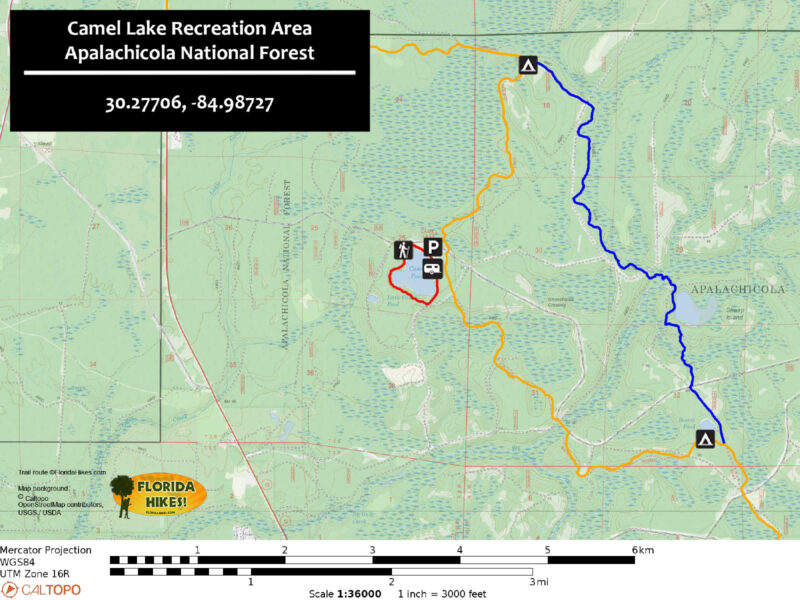
Called the Trail of Lakes, this 9.5 mile loop spans pine flatwoods, titi swamps, and sandhills, with two primitive campsites along it.
 Trail of Lakes Using a portion of the Florida Trail to make a loop, the 9.5 mile Trail of Lakes circles wildflower-filled pine flatwoods, sandhills, and titi swamps, connecting two backpacker campsites near Camel Lake.
The easiest of the hikes, the Camel Lake Loop starts at the far end of the recreation area from the day use parking area. Look for a hiker symbol sign to access the footpath.
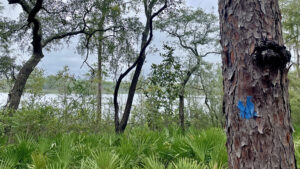 Camel Lake Loop Explore robust sandhill habitats on a short loop hike around cypress-lined Camel Pond at Camel Lake Recreation Area in the Apalachicola National Forest.
Trail Map
Explore More!
Learn more about the Apalachicola National Forest
 Apalachicola National Forest Noted for its botanical beauty, the Apalachicola National Forest is the largest National Forest in Florida, sweeping south and west of Tallahassee.
Slideshow
See our photos from Camel Lake Recreation Area
Nearby Adventures
 Apalachee Savannas Scenic Byway In the Apalachicola National Forest, the Apalachee Savannas Scenic Byway is a winding stretch of scenic road through expansive wet flatwoods and open pine savannas
 Wright Lake Trail At Wright Lake Recreation Area near Sumatra, a day hiking loop along the western edge of the Apalachicola National Forest features an unusual bridge and numerous pitcher plant bogs.
 Garden of Eden Trail Try one of Florida's toughest day hikes on for size: local legend has it this was the Garden of Eden, and from the lush forests and rare flora along this trek, they might be on to something.
 Torreya State Park Perched on bluffs above the Apalachicola River, Torreya State Park is one of Florida’s first state parks, developed by the Civilian Conservation Corps in the 1930s

- Michael Crotty Bicentennial Park - November 3, 2026
- A.J. Henry Park - November 1, 2026
- Okeeheelee Nature Center Trails - October 22, 2026