

One of Florida’s more impressive archaeological parks, this interpretive site along Crystal River includes six middens and the only known stele in the southeast United States.
Waterways were the primary method of travel and commerce for the people who once lived in this village along Crystal River, roughly halfway from Kings Bay to the Gulf of Mexico.
 Crystal River flows past the village site
Their trading partners reached as far north as the Hopewell culture in Ohio and the Great Lakes, with copper from Michigan discovered among the artifacts here.
Archaeological research at the site began prior to the Civil War, with significant finds made in 1903. Digs continued through the 1950s.
 An airy museum displays artifacts found on this site
Resources





Disclosure: As authors and affiliates, we receive earnings when you buy through our links. This helps us provide public information on this website.
Overview
Location: Crystal River
Length: 1.1 mile loop
Trailhead: 28.909798,-82.62895
Address: 3400 N Museum Point, Crystal River
Fees: $3 per vehicle
Restroom: At the museum
Land manager: Florida State Parks
Phone: 352-795-3817
Open 8 to sundown. Museum open 9-5 Thu-Mon. Leashed dogs permitted except inside the building.
An accessible network of paved trails connects points of interest, and interpretive markers illuminate each stop.
Directions
From the intersection of SR 44 and US 19 in Crystal River, drive north on US 19 for 1.9 miles. Turn left onto State Park Dr. Continue 1.1 miles to Museum Point. Turn left. The road crosses a bridge and ends at the parking area for the park after 3/4 mile.
Hike
Start your walk by entering the simple but elegant museum built soon after this archaeological treasure became a Florida State Park in 1962.
It is an architectural showcase, is a classic piece of mid-century modern design. Natural light illuminates its artifact displays. A short movie provides an overview of the site.
 The museum
From the back wall of the museum, exit out the back door to walk up to Stele 2, one of two stone monuments discovered within the complex.
Protected by a small fence, it lines up with the ramp at Mound H on the far side of a large bog.
 Stele 2
Follow the walkway past the side of the museum towards that bog, passing a rise under the oaks marked as Mound G, the first of the burial mounds.
The bog itself is thought to have been a plaza below flat-topped Mound H, which may have served as a stage given the well-formed ramp.
 Bog and Mound H as seen from Mound G
Ancient oaks and tall cabbage palms crown the mound, but these mounds are far, far older than any of the trees growing along Crystal River today.
Loop around the bog to reach a cluster of four mounds, the Main Burial Complex. It was here that archaeologists unearthed many significant artifacts now displayed in museums.
 Main Burial Complex
Take the next turn to the left, which leads to Stele 2 at the edge of the park. Protected by a roof, this rock monument has a carving traced into it.
It is Florida’s only petroglyph. The stone is soft and the artwork ancient, but the interpretive sign helps in detecting the fading face.
 Stele 2
Return to the outer loop and turn left to walk to the waterfront, where the paved path ends at the picnic area.
A stroll along the seawall netted us sightings of both manatees and dolphins in Crystal River. Fishing is allowed along the seawall.
 Seawall along Crystal River
This vantage point showcases Mound A rising above the river and surrounding estuary. It’s obvious from this angle that a portion of it was carved into for fill long ago.
Mound A is the tallest of the mounds and has an observation deck on top. Walk past the outdoor amptheater to follow the paved path to its base.
 East side of Mound A
It’s a steep climb up the stairs but worth it. You’re in the tree canopy, looking out into it.
The temple mound provides a sweeping view downriver, facing the direction any trading partners would have paddled in from the Gulf.
 Staircase to the top of Mound A
Descend carefully and stay left at the next junction to walk along a final set of mounds fronting the salt marsh, a series of middens.
This prehistoric landfill yielded many interesting objects tied to everyday life in the village, from shell and bone tools to sharks’ teeth.
 Middens along the exit route
The paved path loops past a pretty palm-lined marsh to return to the main entrance to the museum. Our full circuit of the park tallied 1.1 miles.
Since the park is open until sunset, some visitors come simply to watch it from the top of Mound A.
 Crystal River from the top of Mound A
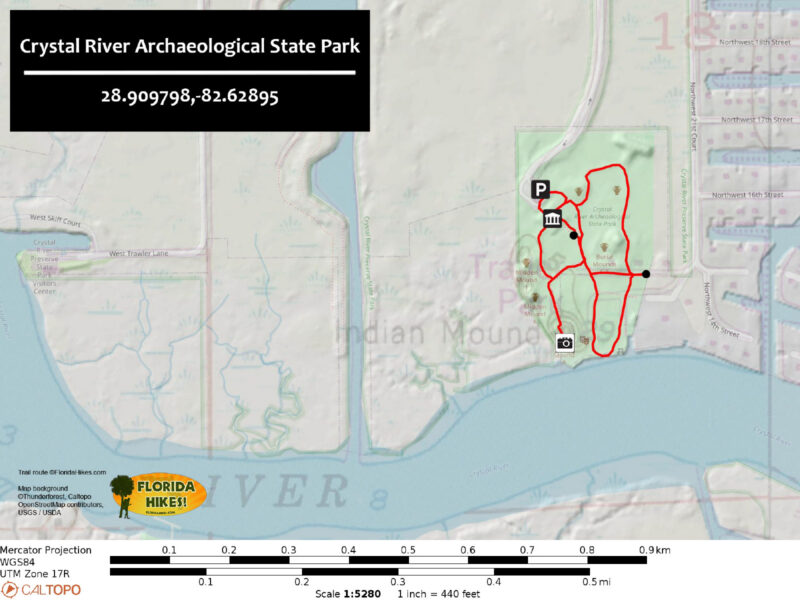
Trail Map
Explore More!
Learn more about surrounding Crystal River Preserve State Park
 Crystal River Preserve State Park Crystal River Preserve State Park spans 20 miles of the Gulf Coast between Yankeetown and Homosassa, protecting key manatee habitats along estuaries of the Gulf.
Video
A virtual walk through the mound complex
Slideshow
See our photos of Crystal River Archaeological State Park
Nearby Adventures
 Crystal River Eco-Walk Traversing floodplain forests and mesic flatwoods, the ecological diversity of the Eco-Walk Trail is stunning, though at times it may require wet shoes to complete the loop.
 Churchhouse Hammock Trail Explore a showy coastal hammock within Crystal River Preserve State Park from an easily-accessed pair of loops just north of downtown Crystal River.
 Kings Bay River Walk Discover a variety of unexpected perspectives on coves, springs, and the expanse of Kings Bay along a marked walkway stretching around downtown Crystal River.
 Three Sisters Springs An important gathering place for manatees during the winter months, this beautiful cluster of springs along Crystal River can be visited by land or by water.

- Hal Scott Yellow Trail - November 3, 2026
- Hal Scott Preserve - October 28, 2026
- Tradewinds Park - October 27, 2026