
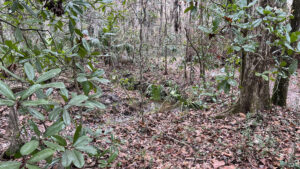
It’s a relict of the ancient past, a collect of grand trees, some centuries old, in folds in the landscape below a ridge above Brooksville.
Fickett Hammock almost became a subdivision. Instead, it’s a celebration of botanical wonders.
 Among the ancients
Marvel at massive swamp chestnut oaks, normally found much farther north in Florida, on terrain deeply cut by an ephemeral stream.
In a forest also dense with magnolias and Florida maples, the feel of walking this trail is like being among the ravines of Tallahassee.
Fickett Hammock marks the southernmost extent of rain lily, an early season flower most commonly seen along the Suwannee River basin.
 Florida maple in winter
Resources





Disclosure: As authors and affiliates, we receive earnings when you buy through our links. This helps us provide public information on this website.
Overview
Length: 2.3 miles
Trailhead: 28.613875, -82.468750
Address: 15482 Centralia Rd, Brooksville
Fees: Free
Restroom: None
Land manager: Hernando County
Phone: 352-754-4031
Open sunrise to sunset. Leashed dogs welcome; pick up after your pet.
Directions
Follow US 98 north from Brooksville and turn south on Citrus Way. Continue to its junction with Centralia Rd and turn right. The trailhead is on the south side of the road before you get to the Suncoast Parkway overpass.
Hike
Behind the trailhead kiosk, open the pedestrian gate. A red hiker medallion and arrow points to the rightmost trail corridor.
Start the loop counterclockwise, passing through a bald spot in the hammock where storm-damaged trees have been cleared.
 Trailhead kiosk
Walk under a cabbage palm, rounding a slight bend. The forest closes in, the footpath leaf-strewn. Oaks of significant size tower above.
A tenth of a mile in, cross a forest road where arrows point straight ahead. While the arrows are sometimes helpful, the pathway is obvious.
 Worn footpath
At a curve, a gash in the side of a massive oak reveals its trunk’s interior after a portion of the tree peeled away in the wind.
After a cluster of magnolias, arrows point straight ahead past another forest road. Beyond a magnificant live oak, the hardwood hammock becomes more lush.
 Base of an enormous live oak
Reach the trail junction for the top of this loop at a bench at 0.4 mile. Turn right to cross the bridge spanning an often-dry drainage.
Magnolias become more prevalent, keeping the hammock bright green when the oaks lose their leaves.
 Junction at bench
Curving through the dense forest, ascend through a stand of palms over a small rise and descend towards the stream basin.
In its deeply eroded but narrow channel, the tannic waterway curls past young magnolias and under the next bridge.
 Tannic waterway
The upper loop begins just past the bridge at 0.6 mile. Bear left to begin this loop clockwise.
The massive leaves on the forest floor are from a preponderance of swamp chestnut oaks. Like the Florida maples, they lose their leaves in winter.
 Lush hammock
Cabbage palms tap into hidden water sources below the forest floor. The understory gradiates from open to extremely tangled on the progression around the loop.
The hammock becomes more dense, the contrasting shapes of fronds and leaves and thick oak trunks fascinating even when wet.
 Among the palms
Climb a slight rise at a mile, the footpath revealing white sand beneath its blanket of leaves. Winding through a palm hammock, descend past sizable swamp chestnut oaks.
Wild coffee makes a surprising appearance, more commonly found in South Florida and close to the warmth of the coasts.
Looking more like mossy limestone than wood, a gnarled base of an oak is all that remains of a once grand giant of the forest.
 Unusual eroded oak base
After several more twists and turns through palm fronds, emerge at the end of the loop at 1.4 mile.
Cross the bridge, enjoying a better perspective of the adjoining tannic waterway on the tenth of a mile walk back to the lower loop.
 Bridge to lower loop
Pass a 1-1/2 mile marker before reaching the bridge. Bear right, passing the bench.
The trail curves to parallel the waterway flowing through the preserve, offering glimpses of the folded landscape below.
 Paralleling the waterway
Oaks predominate, their saplings filling in the gaps between saw palmetto. Magnolias, cedars, and sparkleberry add their textures.
Well worn to sand by use, the footpath curves between walls of greenery.
 Habitat transition
By 1.9 miles, a soft carpet of pine needles signals a shift in habitat towards the sandhills more common to this region.
As the trail ascends, the canopy thins. The mix of oak species expands to water oak and bluejack oak.
 Relict sandhills
Reach a bench at 2.1 mile with a trail marker offering two options. Both return to the trailhead, straight ahead more directly using an old road.
Take the right turn for the scenic route. This much narrower path descends into the hammock.
 Final junction
In a surprising contrast, sprays of wild coffee peep from the leaf litter of swamp chestnut oaks.
Curve past cabbage palms and bluestem palms, popping out of the forest facing the kiosk at 2.3 miles.
 Wild coffee and swamp chestnut oak leaves
Trail Map

Explore More!
Video
Hiking Fickett Hammock Preserve
Slideshow
See our photos from Fickett Hammock Preserve
Nearby Adventures
 Annutteliga Hammock Trail Explore fascinating karst topography with exposed limestone under a shady canopy in the Withlacoochee State Forest, passing a primitive camping area along this 4.8 mile loop.
 Citrus Hiking Trail 39.1 miles. Savor a rugged hike through rolling hills and rocky terrain on one of Florida's longest backpacking loops when you take on the Citrus Hiking Trail near Inverness
 Chinsegut Conservation Center Tract Discover the beauty of May's Prairie at the heart of the Chinsegut WEA Conservation Center Tract, a vast wetland where sandhill cranes gather.
 Annutteliga Hammock Conservation Area Part of a wildlife corridor between the Withlacoochee River and the Gulf of Mexico, Annutteliga Hammock Conservation Area protects 570 acres of sandhills, scrub, and prairie immediately east of Chassowitzka WMA.

- Michael Crotty Bicentennial Park - November 3, 2026
- A.J. Henry Park - November 1, 2026
- Okeeheelee Nature Center Trails - October 22, 2026