
Green heron
Green herons look very much like the American Bittern from a distance. But the way they hold their neck and the iridescent green of the feathers on their backs help make them easy to identify.

Florida Hikes
Hike Bike Paddle Camp Florida with authors Sandra Friend and John Keatley as your guides
Identification of common and unusual bird species seen in Florida.
Green herons look very much like the American Bittern from a distance. But the way they hold their neck and the iridescent green of the feathers on their backs help make them easy to identify.
Chestnut-brown with white spots, the limpkin has a curved beak much like an ibis. It is one of Florida’s more rare birds, and has been listed on the protected species list. Its diet consists mostly of the apple snail.
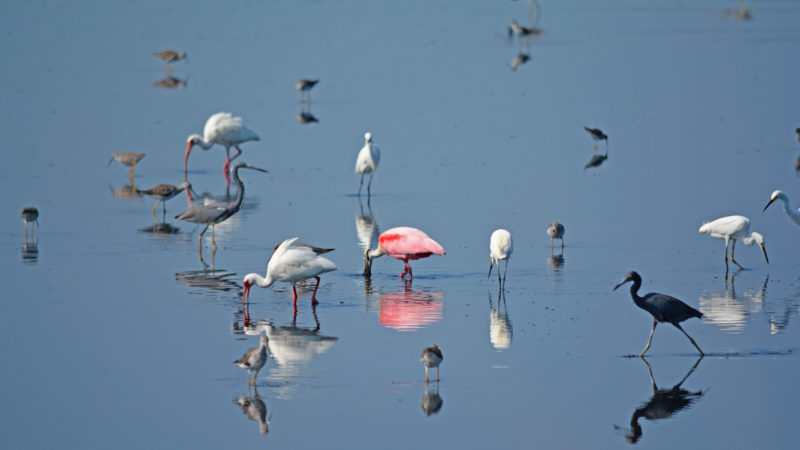
Few wading birds sound genuinely upset when you walk past them, but the little blue heron sure kicks up a fuss - and usually moves away quickly, no matter how softly you walk.
A distinctive white-bellied blue heron, the Louisiana heron is also known as the tricolored heron.
One of the noisiest residents of the marsh, the moorhen - also known as the common gallinule or marsh hen - has a distinctive red beak compared to their cousins the coots.
A dabbling duck, the mottled duck floats along the surface of the water and daintily dabs its bill into the water to feed, or tips over to reach vegetation at the bottom.
The osprey is a large black and white raptor, up to two feet tall and with a six-foot wingspan. It dives for fish and is found near freshwater and saltwater habitats.
Florida's most beautiful waterbird is the purple gallinule, found year-round in fresh water marshes in the Florida peninsula.
One of the most distinctive sounds you'll hear in a Florida marsh is the call of the red-winged blackbird, particularly when there are a large flock of them.
There's no mistaking the roseate spoonbill, with its bright pink plumage and distinctive shovel-shaped beak. Usually seen in pairs or large groups, they feed on mud flats.
Tall, distinctive birds that you'll see everywhere in the Florida peninsula, sandhill cranes mate for life and travel in pairs or as a family.
Sometimes mistaken for other white wading birds in Florida, the snowy egret has distinctive yellow feet and a black bill.


