
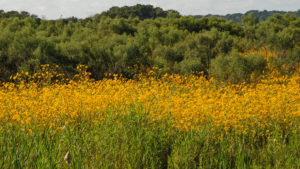
While driving to the coast last week, we noticed the St. Johns River floodplain was lined in bright yellow with the blossoms of swamp sunflowers.
So early this morning we set out for a hike along the shore of Lake Jesup, part of the St. Johns River system.
We were looking for the yellow glow of the masses of flowers, and GPSing a section of the trail that Sandy hadn’t tracked previously.
We didn’t get there as as early as planned, as we had to find all the things needed to go on a short hike. Sure, we’ve spent three months hiking this year on the AT. But going on a day hike is different.
Long distance hiking means that it has to be in you pack. Or you do without! Day hiking – after months of being out of practice – means finding all our gear again.
Luckily the daypacks, themselves, were in our storage closet. Packs, water, camera, hiking sticks, hats, bug spray, and GPS…….. we’re off!
Arriving at the kiosk, we find the batteries in the GPS are down to the last bar. After a trip back to the car, we realized that they were in the bag we forgot to bring.
Not to worry, this is why we made sure that our little cameras use the same AA batteries as the GPS. A quick swap and we’re on our way.
With packs on and the GPS running, we walk down the trail. It wasn’t long before we were surrounded by sunflowers. Both sides of the trail lined in yellow flowers taller than us.
Dodging large puddles from recent rains, we came to a “damp zone”.
Here’s where Sandy’s hiking experience is different than mine. She is a “swamp walker.” She and her many friends take pride in the fact that they wade along the trail. Sometimes I even think “the deeper the better” for them.
Me, the one in waterproof boots, looks and sees that it’s deeper than the top of my boots. If it that deep, I’m looking for a drier path!
What I’ve learned is that in the swamps of Florida, there often is no way around.
After the first water obstacle, we arrive on a berm and continue along the top of it. Looking along both sides of the trail, all I see are ditches, swamps and palms.
Until off to our right I see the blue of Lake Jesup in the horizon. The view doesn’t last long before we step off of the berm and head off on the loop trail.
With each step the brush becomes thicker, and before long the trail vanishes. We look for any worn path. There is none. The invasive casearweed has taken over the forest floor.
We wade through these plants, often as high as our chest, looking for the next marker. One marker at a time, we blaze a trail where we think it be.
Luckily, we kept seeing the next marker as we bushwhacked along. Twice we were we tempted to turn back: first at what appeared to be a creek wider than we wanted to forge, and second when the markers seemed to just end.
On closer examination, we found a narrow place with only a step or two across the canal. And after much searching, Sandy found two rusty screws on a tree where the marker had once been.
The best thing about doing the loop trail was that we had the chance to walk through the beautiful sunflowers a second time.
Until a great deal of trail maintenance has taken place on the South Loop, and something is done about the casearweed, I wouldn’t recommend hiking any farther than needed to see the beautiful sunflower-lined paths.

- Riding the East Coast Greenway to Stuart - July 14, 2022
- Pioneer Paddling Trail - May 11, 2022
- Launching Into Paddleboarding - October 17, 2021