
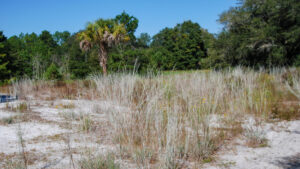
Acquired in 2002 to preserve 110 acres of upland recharge near Rock Springs, the Western Addition to Kelly Park centers on what was once Prairie Lake.
If you poke around enough, you’ll find the spring vents. But it’s been decades since they went dry, victims of a dropping water table as development swarms across the region.
 Two loops make up the Western Addition trails
Resources





Disclosure: As authors and affiliates, we receive earnings when you buy through our links. This helps us provide public information on this website.
Overview
Location: Apopka
Length: 1.7 mile loop
Trailhead: 28.757771, -81.503683
Address: 400 E Kelly Park Rd, Apopka 32712
Fees: $3 per carload for 1 or 2 passengers, $5 for 3-8 passengers
Restroom: At swimming area
Land Manager: Orange County Parks & Recreation
Phone: 407-254-1902
Dogs are not permitted. Open 8-8 summer, 8-6 winter (daylight savings time). If you wish to backpack to the primitive campsite, call ahead for details.
The campground is an excellent family getaway, especially when paired with the outdoor recreation opportunities of the park. Check ahead for reservations.
Directions
From Interstate 4 in Altamonte Springs, follow SR 436 (Semoran Blvd) to Apopka, where it joins into US 441. Turn north (right) onto Rock Springs Rd (CR 435). Drive 5.8 miles to Kelly Park Rd. You’ll see a tubing rental place on the corner. Turn right. Follow the road around less than a half mile to the park entrance on the right. Pay your entrance fee at the ranger station. Turn left immediately past the ranger station into the parking area for the environmental center.
Hike
Start by walking past the ranger station down the median of the park road. At the first green post along the bark chip path, turn left and make a beeline for the front gate.
Cross Kelly Park Road. Go around the right side of the Kelly Park Fire Department building. Head for the fenceline to find the gap in the fence leading to the Western Addition trails.
The Oakhill Trail is blazed blue, and the Prairie Lake Trail in red. Our route combines the best of the two loops for a 1.7 mile hike.
 Trailhead for the Western Addition
Begin by following the forest road with both red and blue blazes, shaded by oaks with longleaf pine towering overhead.
It sits on a transition zone between scrub and sandhill. Wiregrass fills the spaces on the forest floor between young Chapman and myrtle oaks.
Clusters of cabbage palms tap their deep roots into the underground streams funneled towards Rock Springs Run.
 Forest road
After a quarter mile reach the fork where the outer loop begins. Follow the red blazes of the Prairie Lake Trail.
Pass a bench and an interpretive marker about live oaks as the trail swings right and descends through the sandhills, reaching the fork where the Prairie Lake Loop starts.
Skirt a small depression marsh, curving away from it to pass a bench flanked by saw palmettos and around a deep, well-established sinkhole.
 Sinkhole with vegetation inside
The Oakhill Trail joins the Prairie Lake Trail at a junction to the right. Stay left.
Emerging from the woods, skirt an open prairie rimmed by scrub forest. Low bush blueberry edges the footpath and tufts of chalky bluestem grass wave in the breeze.
Pass a bench that works well for wildlife watching before the trail sweeps into the shade provided by sand live oaks draped in Spanish moss.
 Scrub-edged prairie
Entering the sandhills, walk between young turkey oaks. Wildflowers dot the forest floor in fall, the purple feathers of blazing star particularly showy.
A triple junction of trails marks the top of the loop of the two intertwined trails. Turn left to stay on the Prairie Lake Trail.
As the trail loses elevation, the habitat quickly transitions from sandhill to hardwood forest with ferns and grapevines in the understory.
 Blazing star in the sandhills
An arm of the prairie reaches into the woods, with the potential of a depression marsh.
The trail is slightly elevated as if it were on a causeway. Cabbage palms grow along the prairie rim, which was once the shore of Prairie Lake.
 Grassy prairie
Meander past a sweep of grasslands that would attract deer. Wild persimmons grow in this open area.
Adding to the odd mosaic of habitats, a baygall fills a small depression, and Virginia willow sprouts in the open prairie.
Perhaps part of the lake persists underground, still nourishing these water-loving species?
 Cabbage palm with goldfoot fern
Reach the next trail junction. Red arrows point out a route into the oak scrub. Proceed into it. At 1 mile, a connector comes in from the left leading to Prairie Lake Camp.
Take a trip down the spur to see the open spot reserved for primitive camping. Returning to the main trail turn left. Lopsided Indiangrass catches the sun near the next bench.
Return to sandhill habitat, with tall slash pines and oaks shading the trail and winged sumac flashing its fall foliage.
 Lopsided Indiangrass
At the next trail junction, seal the loop. Walk straight ahead on the broad path through sandhills and scrub, reaching the gap in the fence at 1.5 miles.
Emerge behind the fire station and walk around it. Cross Kelly Park Road to return to your vehicle inside the park, finishing a 1.7 mile hike.
 Forest road
Trail Map

Explore More!
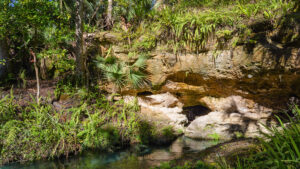 Kelly Park Tubing Rock Springs Run is why most folks visit Kelly Park, but the Kelly Loop Trail provides unique perspectives on many more natural features within the park.
Slideshow
See our photos from this hike
Nearby Adventures
 Lake Lucie Conservation Area A shaded loop trail winding through mesic hammocks borders a marsh that was once known as Lake Lucie.
 Trimble Park A superb family destination for its playground and campground, Trimble Park boasts a showy nature trail looping over a mile between two lakefronts.
 Lake Apopka North Shore Across two counties and along the entire north rim of Florida's fourth-largest lake, this 20,000 acre conservation area is a sweep of wildlife-rich marshes.
 Wekiwa Springs State Park A massive wilderness area on the edge of the Orlando metro, Wekiwa Springs State Park is centered on a first-magnitude spring that pours forth a river lined with jungle-like vegetation.

- Michael Crotty Bicentennial Park - November 3, 2026
- A.J. Henry Park - November 1, 2026
- Okeeheelee Nature Center Trails - October 22, 2026