
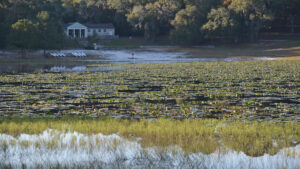
Set in an undulating landscape with lakes formed inside ancient sinkholes, Mike Roess Gold Head Branch State Park centers around an incredible ravine dripping with ferns.
It is at the bottom of the steephead called Gold Head where bubbling springs create a crystalline, sand-bottomed stream, Gold Head Branch.
 Springs come together to make the creek
Gold Head Branch State Park is one of Florida’s earliest state parks, built during the Great Depression under a Federal employment program that trained men useful construction skills.
Structures built by the men of Civilian Conservation Corps Company 2444 are still in use, their sturdy architecture and timeless beauty a reminder of the importance of craftsmanship.
 Picnic pavilion overlooking a deep sinkhole in the day use area
Resources





Disclosure: As authors and affiliates, we receive earnings when you buy through our links. This helps us provide public information on this website.
Overview
Location: Keystone Heights
Entrance: 29.847977,-81.961958
Address: 6239 SR 21, Keystone Heights
Fees: $4-5 per vehicle
Restroom: At the day use area
Land Manager: Florida State Parks
Phone: 352-262-8129
Open 8 AM until sunset daily. Leashed pets welcome except on swimming beach.
Directions
From its intersection with SR 100 in downtown Keystone Heights, drive SR 21 north 6 miles to the state park entrance station.
About the Park
The park is centered around two significant natural features, a steephead ravine and a large lake.
Steep flights of stairs guide visitors into the depths of Gold Head, where springs bubble up in a gully of ferns to create its namesake waterway.
 The switchbacked ramps and stairs into the ravine
Over geologic time, Gold Head Branch carved a deep ravine it flowed into a low spot in the sandhills.
As the waters spread, it formed Little Lake Johnson and Big Lake Johnson. A large prairie connects the two, which on rare occasion dry out or swell to merge together.
 Prairie between the lakes
Along Little Lake Johnson, a bathhouse sits on a terrace above a swimming beach with canoes for rent.
The interior of the bathhouse is worth checking out, as it’s another excellent example of Civilian Conservation Corps craftsmanship.
 Inside the bathhouse changing room
Above the lake, a large day use picnic area sweeps around one side of the lake beneath the pines and oaks.
Some of the original stone-and-concrete picnic tables are still in place from the 1930s. They are fascinating, but not as comfortable as modern wooden benches.
 CCC-era picnic table
The Recreation Hall at the top of the hill was once part of the Civilian Conservation Corps camp, a gathering place for the men.
It’s within sight of the large day use parking area, which connects past the Recreation Hall to the bathhouse area using a very unusual undulating ribbon of concrete sidewalk.
 The roller-coaster sidewalk
Camping
Families come back to Gold Head year after year for the superb camping. Two separate campgrounds host RV and car campers on sites tucked into shady forests.
The Sandhill Camping Area has two loops, Sandhill and Turkey Oak, within a short walk of the day use area at Little Lake Johnson.
 Tent set up on the Sandhill Loop
The Sandhill Loop is a particularly pleasant location for tent camping and convenient to all the trails.
RV campers may prefer the Lakeview Camping Area farther along the entrance road past the cabin areas. On a hill off the entrance road, it’s in a relatively quiet corner of the park.
 Campers in the Lakeview Loop
We’ve enjoyed our stays in the vintage Civilian Conservation Corps cabins, which are cozy and perfect for a couple.
Most have a single room inside with vintage wooden furnishings and a fireplace. Each has a small bathroom and kitchen.
 Inside the Dogwood cabin
A tiny screen porch looks downhill towards Little Lake Johnson. There is also a fire ring area outside, a place to gather with friends in the evenings.
Large, modern state park cabins, some with accessibility in mind, sit closer to the day use area and are the size of a small home. Each has multiple rooms, perfect for families.
 John on the screened porch
Hiking
Some of the trails within the park were established by the young men of the Civilian Conservation Corps.
They hand-hewed trail posts and built staircases out of chiseled limestone blocks.
 Stone walls and staircases at the beach
The oldest of the trails is the descent into Gold Head Ravine, which has its own parking area along the park road above the steephead ravine.
The Loblolly Trail and Ridge Trails circle the ravine and the Ravine Trail descends into it. The orange-blazed Florida Trail overlays the Ridge Trail for a portion of its route.
 Gold Head Ridge and Ravine Trails A beauty spot with extreme elevation changes, Gold Head is best explored along the Ridge and Ravine Trails that guide you into and around the bottom of the steephead ravine.
 Florida Trail, Gold Head Branch Following high ground above Devils Washbasin and Gold Head Ravine, the oldest section of the Florida Trail at Gold Head Branch State Park makes for a pleasant six-mile round trip.
 Trails at the bottom of the ravine
In the late 1960s, the Florida Trail Association blazed its first route through the park and had a backpacker shelter along it within sight of Little Lake Johnson.
The original AT-style shelter no longer exists, but there is a primitive camping area for backpackers with a picnic shelter not far from where the original used to be.
 Shelter at the primitive camping area
Almost seven miles of the Florida Trail extends linearly across the park, with three trailheads providing access to it and other trails.
The trailhead adjoining the entrance station also is the closest parking for hiking the Florida Trail into Camp Blanding across from the park.
 Florida Trail, Camp Blanding Explore the high ground of Keystone Heights through sandhills and scrub on undulating terrain across forests managed by the Florida National Guard at Camp Blanding.
One section of the Florida Trail heads east from the day use area along the shoreline of Little Lake Johnson into the sandhills near the Lakeview Camping Area.
After a mile and a half it reaches a stile providing walk-in access to another new section of the Florida Trail in a conservation area across Christian Camp Rd.
 Florida Trail, Gold Head to Smith Lake Preserve Southbound from Little Lake Johnson at Gold Head Branch State Park across Smith Lake Preserve, this 3.3 mile linear hike traverses upland forests along a trio of scenic lakes.
As we’ve learned by trying it ourselves, using the park road as a connector to make loops results in a lot more mileage than you’d expect. The trails are more efficient.
However, the Keystone Bike Path adjoining the park along SR 21 can be used to loop back to the entrance station from the Florida Trail northbound or in Camp Blanding.
 Florida rosemary along the Florida Trail in the sandhills
A short walk along the park road from the Ravine Trail parking area leads to a quarter-mile nature trail to the hidden beauty of Sheelar Lake.

Trail Map

Explore More!
Slideshow
See our photos from Mike Roess Gold Head Branch State Park
Nearby Adventures
 Palatka-Lake Butler Trail With a corridor spanning nearly 50 miles through North Florida, the Palatka-Lake Butler State Trail provides paved trail for riders and an unpaved corridor used by the Florida Trail
 Belmore State Forest Crossing a landscape of remarkably resilient trees in a desert-like environment, the Satsuma Trail showcases the adaptability of certain species native to Florida.
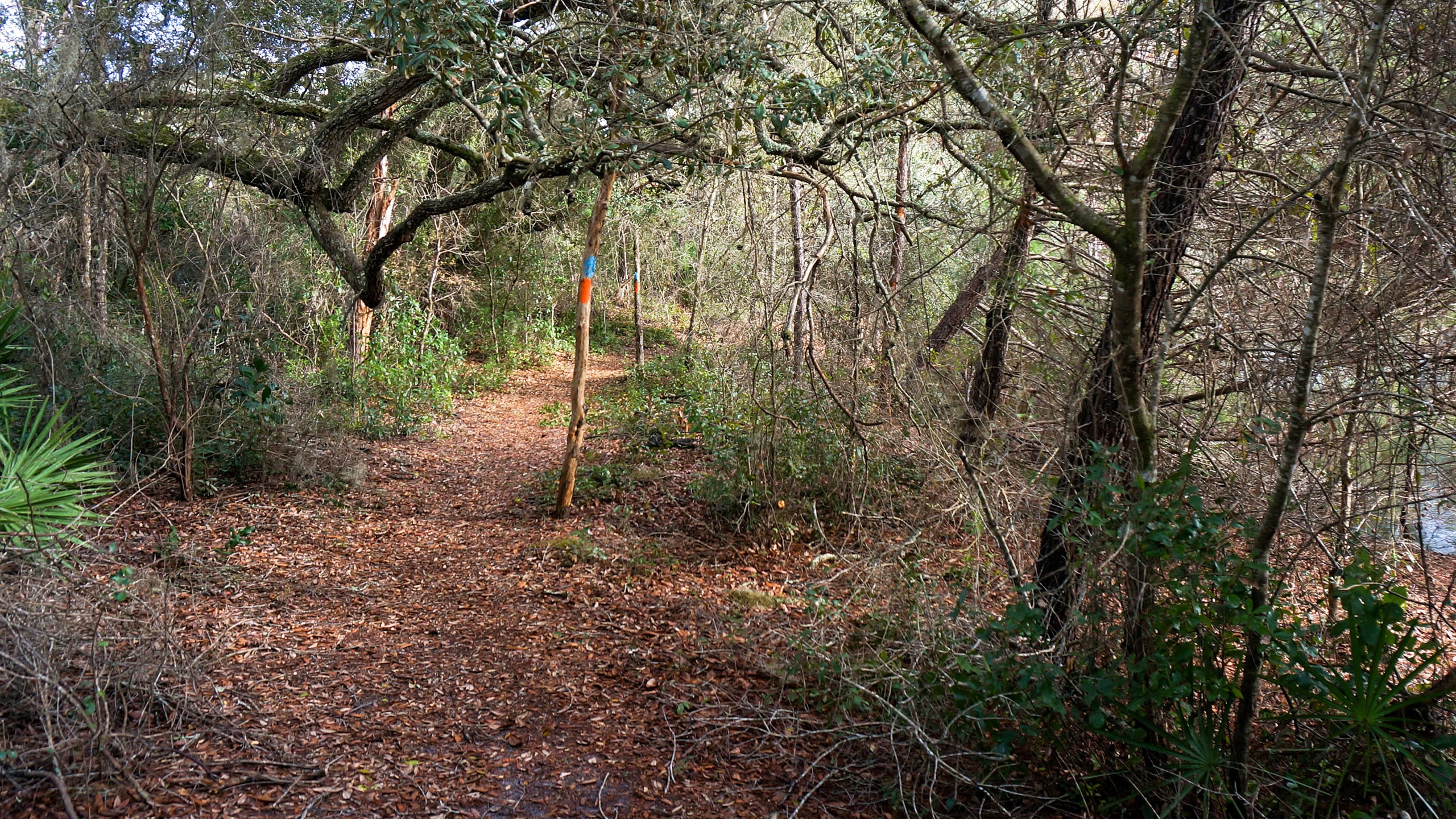 Florida Trail, Etoniah West Large sinkholes, rare plants, and wildlife sightings make this 3.6 mile Florida Trail segment on the west side of Etoniah Creek State Forest an interesting day hike.
 Florida Trail, New River to Hampton A surprisingly pleasant section of the Florida Trail that sees very few hikers, the most remote part of the Palatka-Lake Butler Trail stretches 9.3 miles between Hampton and the New River, southwest of Starke.

- Fort Matanzas National Monument - November 21, 2026
- Carney Island Conservation Area - November 19, 2026
- Hal Scott Red Trail - November 13, 2026