

A place of beauty that morphed from phosphate pits to a botanical attraction over the course of a century, Rainbow Springs State Park is a park with many facets.
It cradles one of Florida’s most beautiful first-magnitude springs and the river it creates in a wrap of shady forests and gardens.
 Gardens above a cove in the Rainbow River
Resources





Disclosure: As authors and affiliates, we receive earnings when you buy these through our links. This helps us provide public information on this website.
Overview
Location: Dunnellon
Main entrance: 29.10324, -82.44977
Address: 19158 SW 81st Place Rd, Dunnellon
Fees: $2 per person at headsprings. Call 833-945-2925 for information on season tubing rental and shuttle fees.
Restroom: At the terrace and near the swimming area
Land manager: Florida State Parks
Phone: 352-465-8555 (campground: 352-465-8550)
Open 8 AM until sunset daily. Leashed pets welcome, but not in swimming areas. Canoe rentals available.
The campground and tubing entrances are downriver from the park and there is no direct connection between the main portion of the park and the campground or tubing entrance.
Directions
29.086758,-82.41712
29.066457,-82.4195
29.103296,-82.449937
The main entrance is on the west side of the Rainbow River north of Dunnellon along US 41, while the campground and tubing entrance are on the east side of the river off SW 180th Ave Rd, north of Dunnellon High School.
About the Park
Sandra’s first visit to Rainbow Springs was in the early 1960s, when it was a popular roadside attraction with submarine-style boats where you could stare fish in the face.
Designed and planted in the 1930s, the gardens and dramatic waterfalls made use of rugged terrain left behind from mine tailings.
 Submarine boats and riverfront lodge in 1967 (Linda Friend)
From the late 1800s through the 1920s, the headspring was surrounded by the earliest open-pit phosphate mines in Florida and the long-forgotten town of Juliette.
Once it was reborn as destination of natural beauty, tourists sought out this magical place until Walt Disney World opened.
 The original US 41 entrance fountain (Linda Friend)
The park was declared a National Natural Scenic Landmark, but its doors closed when visitation dropped.
Threatened by development in the late 1970s, it was bought by the citizens of Marion County and turned over to the state to become Rainbow Springs State Park.
 Landmark monument on the main terrace
Today, the park is a delight for paddlers, snorkelers, and swimmers, thanks to its many bubbling springs.
The first-magnitude spring creates one of Florida’s loveliest and clearest rivers, a delight to behold from its garden paths.
 The Rainbow River flowing from its headspring. Its waters are added to by thousands of tiny bubbling springs.
Birders will appreciate the number of species stalking the river’s edges, for there are many shallow coves where fish are easy to spot.
Seasonally, tubing opens up along a run from a put-in downriver from the campground to Blue Run Park. Local dive shops offer guided river tours.
 Takeout at Blue Run Park
The Gardens
In the main part of the park, paved paths established between the 1930s and 1970s ramble up and down steep hillsides through the long-established gardens.
From the main terrace, one sweeps downriver along its west side, providing an up-close look at the headspring and swimming area, repurposed from the old submarine boat dock.
 Swimming area near the start of the Rainbow River
Crossing a cove full of bubbling springs and rounding a spring where a cabbage palm arcs above the water, that pathway ends at the canoe launch.
The network of trails to the left from the terrace divide to make a loop above and below two manmade waterfalls, Seminole Falls and Rainbow Falls.
 Descent towards the river
The lower trail leads along the river’s edge, first visiting a spring-fed cove across the river from the swimming area.
Crossing a bridge over another pool created by a spring, the path passes showy Seminole Falls and structures that once housed otters and turtles at the attraction.
 Seminole Falls
A boardwalk to the right passes through a dense stand of bamboo to reach an observation deck along the river.
It edges the mouth of a spring-fed cove. In the 1970s, Huck Finn-style rafts docked here, carrying passengers across the river from what’s now the canoe launch.
 River view from boardwalk’s end
Passing the inner part of that cove, note the many tiny bubbling springs near the shoreline. Unlike the falls, these are all-natural.
The next falls to catch your attention, on the right, splash down a hillside with a switchbacked path.
 Cove with bubbling springs
In the days of the attraction, this spot was a walk-through aviary, although a unique leaf-shaped monorail called the Forest Flite entered and exited it as well.
The splashing showcase of the gardens was and still is Rainbow Falls, opposite the former terraced aviary and its winding path.
 Rainbow Falls
The lower path lets you frame the plunging cascade through tropical vegetation, but there is also an upper observation deck accessed from the hilltop path.
The stonework of that deck–and the terraces below it–once supported the Terrace Restaurant.
 Rainbow Falls terrace as seen from Aviary Falls
A steep climb follows, with two broad paths to choose from that meet at the top. To the left is the return walk through the hilltop gardens.
That trail splits around gardens surrounding two manmade ponds used as the water sources for both Rainbow and Seminole Falls.
 The pond feeding Rainbow Falls
Returning to the original junction where you chose to go downhill first, continue straight ahead through the azalea gardens.
Take the lower path if you haven’t already, as it offers an overlook with a good view of the headspring from below the main terraces.
 View from the lower observation deck
Returning to the main terrace, a full circuit of the paved garden pathways on both sides of the river tallies a mile.
Since the terrain is hilly, for many people, the paved paths make a satisfying circuit of the park, especially during azalea blooming season.
 The picnic pavilion beyond the terrace was once the Forest Flite boarding station
Hikers can add more mileage by making a left at the hilltop above Rainbow Falls. A side loop at that junction leads through what’s now a picnic area but once was a small zoo.
Beyond it along the wide main path, the area on the right once housed stables. To the left, a Yellow Trail sign beckons you into the forest.
 Entrance to the hiking trails
Hiking
Originally called the Sandhills Trail, a network of natural surface trails starts a quarter mile east of the garden loop beyond what was once the rodeo grounds.
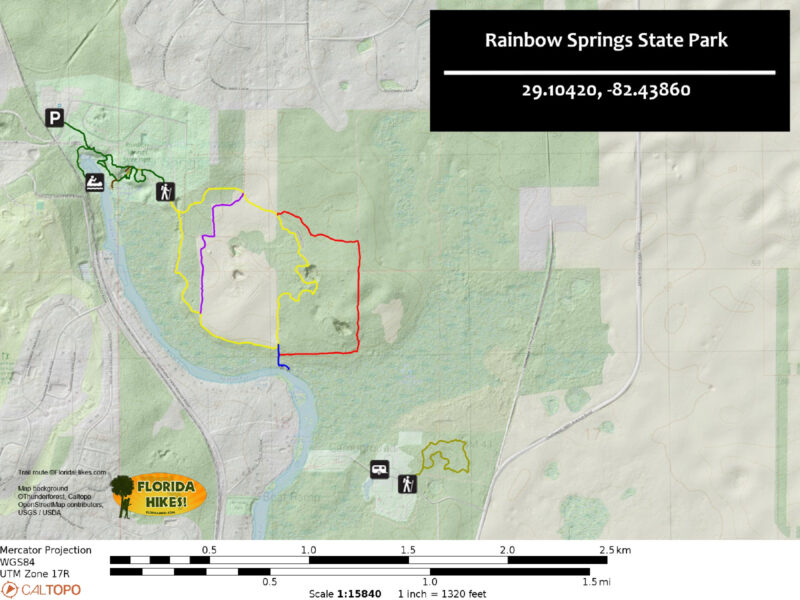
They are blazed yellow, white, and blue, and now referred to by those colors. The Yellow Trail is the access loop, leading through relics of the former mining operation.
 Start of the Yellow Trail
The Blue Trail is a short but worthwhile spur out to a couple of overlooks along the Rainbow River a good ways down from the canoe launch.
The 0.9 mile White Trail skips past the historic mining area along the Yellow Trail.
 Sandhill habitat on the White Trail
Instead, it follows the park perimeter around a healthy sandhill habitat, worthwhile for birding and botanizing.
Hiking the Sandhills Trail still requires a walk through a portion of the gardens, so add another half mile to the loop of 2.9 to 3.3 miles, depending on your route.
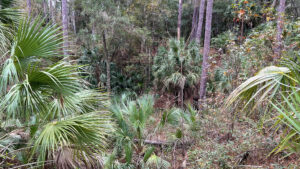 Rainbow Springs Sandhills Trail A stroll through the gardens of Rainbow Springs leads to rolling terrain punctuated with centuries-old ravines created by phosphate mining for a walk into Dunnellon's past.
Camping
Rainbow Springs campground is on high ground east of the river and south of the headsprings via an entirely separate entrance at 18185 SW 94th St.
It’s roughly halfway between CR 484 and SR 40, to the north of Dunnellon High School. A gate code is required for entry.
There are sixty sites across three loops, including some tent-only sites and a number of accessible sites. Each has a picnic table and grill.
Campers have direct access to the river, and can rent canoes and kayaks at the camp store on site. Sites include water and electric, with a dump station provided.
The campground has its own half-mile nature trail loop through sandhill habitat reserved for campground visitors only.
Trail Map
Explore More!
Learn more about Rainbow Springs State Park
 Remembering Rainbow Springs Ready for some nostalgia? Here's a peek at what Rainbow Springs was like back in the 1960s.
 Chasing Rainbows: Florida Springs Protection April is Florida Springs Protection Month, according to our state agencies. A walk through Rainbow Springs State Park confirms that as beautiful as they look, the springs are not in good health.
Nearby Adventures
 Blue Run of Dunnellon Park Enjoy a gentle family-friendly hike along the Rainbow River at Blue Run of Dunnellon Park, where woodland footpaths and paved trails keep you mostly in the shade with dry feet as you explore the river floodplain.
 Florida Trail, Dunnellon 2.3 miles. Tunneling through dense floodplain forests to bridge the Withlacoochee River, the paved Dunnellon Trail segment of the Florida Trail offers accessible users an opportunity to enjoy the outdoors.
 Florida Trail, Pruitt to Ross Prairie 7.5 miles. With switchbacks, scrambles, and ancient oaks, the Pruitt section of the Florida Trail along the Cross Florida Greenway offers a fascinating hike into the history of the Cross Florida Ship Canal.
 Johnson Pond Trail A mosaic of upland habitats along the northern edge of Withlacoochee State Forest surrounds a large prairie long known as Johnson Pond.

- Baseline Trails - November 7, 2026
- Hal Scott Yellow Trail - November 3, 2026
- Hal Scott Preserve - October 28, 2026