
As I lock the driver’s side door of my car and tighten the straps on my backpack, I take one last look at the map I printed for the trail I’m about to take into the Little Big Econ State Forest.
It’s a popular route that appears on all the hiking apps, so I’m sure I could find my way using only the electronic ball and chain that shackle me to the modern world. But on hikes like these, I like to travel back in time.
A paper map reminds me of my Boy Scout days and helps me disconnect from the present, before my mind’s eye locks onto the history I never had the chance to learn in school.
 Staring at a tall oak
The bull that eyes me as I pass through the gate reminds me that these lands were most recently used for grazing.
Ranchers struggling with evolving markets donated their family plots to state land preservation programs to spare them from the developers’ bulldozers.
A few of the old breed still hang on to ever-shrinking plots fringing the forest. But my four-legged ambassador reminds me of how profoundly places can change in just a few years.

Eventually I turn north onto the River Trail into a tunnel of skinny live oaks, the grandchildren of giant forefathers slain more than a century ago by serrated iron teeth.
In the distance I can hear the songs of the depression-era victims of Jim Crow in the turpentine and lumber camps, sentenced to backcountry hard labor for petty offenses to be exploited as cheap labor after slavery had been formally outlawed.
The whistle of a Florida East Coast Railway train, its tracks long removed, calls at a long-gone depot to cart away the remnants of trees that had previously stood here for centuries.
 The Econlockhatchee River
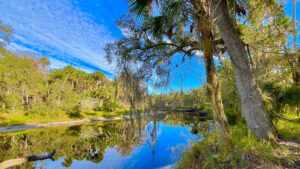
I eventually reach the jungle book Econlockhatchee River, one of the many early superhighways that brought tourists and winter residents to Central Florida before rails and locomotives civilized the region I now call home.
It’s the dry season, and with the bluff and banks unsubmerged, I weave along the southern shore through the cypress and sable palm toward the St. Johns.
As I gaze ahead, an overloaded nineteenth-century paddle wheeler emerges from the foggy mist, its boiler and chimney belching clouds of ash as it moves upriver past alligators sunning themselves on the sandy beaches.
 Beaches at river level
Still, I press further downriver, climbing deeper into the haze. I’m startled by rustling behind my right shoulder, too loud to be a deer or hog, deliberate and invisible.
As I turn to look, the legs of a native warrior spring away and sprint into the forest, then dissolve into yells and gun shots. Perhaps it’s an ambush on reinforcements that strayed too far from the road between Forts Mellon and Christmas during the Second Seminole War.
I crouch among the palmettos, training my ears on the distant commotion, which eventually evaporates into the calls of the hawks.

I soon reach a Timucua fishing village not far from Culpepper Bend among piles of discarded shells, the smell of fish permeating through the cacophony of foreign words I don’t understand.
Through the distance their features are hard to discern, but I still feel their presence. The distant electrical towers have disappeared, the buzz of fuel-injected engines drowned by the songs of people exterminated long ago by pathogens brought by my own ancestors.
 Culpepper Bend
The worlds I see when walking through the forests near my home aren’t hidden or denied. Tantalizing appetizers can be found on plaques and colorful displays in state parks and historic homes.
If you look hard enough, you can find texts in college bookstores that narrow their focus to the memoirs of local communities that few professors have time to squeeze into a syllabus. But one needs to seek out such knowledge.
In a universe of theme parks and strip malls and cookie cutter planned communities, there are precious few places to connect with the people who lived before us in the places we call home.
It is only untethered from the present and while roaming free in our few remaining natural spaces, far from roads and bridges and electricity, where I can discover what it actually means to be a Floridian.
 Path atop the bluffs
Soon it is time to return to the real world, and a glance at the map confirms the way back. Now crumpled in my pocket, it’s more than just a collection of squiggly lines and cross-hatched smears.
It leads me to the forgotten treasures that have not yet been buried by asphalt and concrete. I look forward with youthful delight to my next chance to search for more.
 Reflections off the river
This essay was first published in Intervals.

- Trail To The Past - September 29, 2026
- Sunrise at Kissimmee Prairie - August 7, 2025
- A Forest is Reborn in the Green Swamp - April 8, 2025