
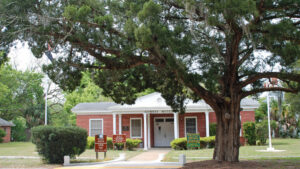
Living in malaria-stricken Florida in the 1850s, Dr. John Gorrie had a problem: how to keep his recovering patients cool?
At the time, ice for refrigeration was cut from frozen lakes and rivers and packed in sawdust for rail transport to Florida.
Fortunately for all of us, he came up with a nifty little device to make his patient’s suffering more tolerable.
 The Gorrie Museum
Resources


Disclosure: As authors and affiliates, we receive earnings when you buy these through our links. This helps us provide public information on this website.
Overview
Address: 46 Sixth St, Apalachicola
Fees: $2 per person admission. Grounds free.
Restroom: At the museum
Land manager: Florida State Parks
Phone: 850-653-9347
Museum open 9-5 Thu-Mon, closed Thanksgiving, Christmas, and New Year’s Day. Picnic tables are provided for visitors.
Directions
Entering downtown Apalachicola northbound on US 98, make a left onto Columbus Street in front of the Gibson Inn. Cross 4th St and 5th St and make a right on 6th St. A parking area is in front of the museum on the left just before the traffic circle.
About the Park
A small green space with large cedar trees surrounds the museum building. Inside, the story of one persistent man’s engineering savvy unfolds.
Dr. John Gorrie first found a way to use compressed air and condensation to make ice. He then ran a fan across the ice to keep his infirmary cool.
His invention was granted the first United States patent for mechanical refrigeration, U.S. Patent # 8080 issued May 1851.
 The original model of Gorrie’s first ice machine has been on display in the Smithsonian since 1939. K.M. Perry of the engineering division of the Smithsonian is looking over the device before installation.(Harris & Ewing, 1939)
Creating ice was a revolutionary idea, especially in the hot-as-blazes months of the summer in the South.
Prior to Gorrie’s invention, the problem was ice storage. Supplies laid up in the winter months usually ran out by the end of July, and August was a terrible month for yellow fever.
Adding a fan across the ice as a “swamp cooler” meant Gorrie created the first air conditioning system as well. But it was too advanced for his time.
 Details on the state historic marker at the museum
Sadly, Gorrie died in obscurity in 1855. He is buried in Gorrie Square across the street from the museum.
It wasn’t until the 1890s that ice merchants discovered the magic of his system, which led to the design of air conditioning.
Erected in 1899, a monument catty-corner to the museum next to Trinity Episcopal Church honors Gorrie.
 The Gorrie Monument
The grandly carved monument was placed there by the Southern Ice Exchange, which undoubtedly benefited greatly from Gorrie’s invention after his patent lapsed.
In 1911, Gorrie was honored with a statue as one of two representatives of Florida history in the U.S. Capitol Building in Washington, D.C.
 Florida’s memorial to John Gorrie, M.D. Statuary Hall, U.S. Capitol, Washington, D.C. (Harris & Ewing, 1936)
Explore More!
Nearby Adventures
More worth exploring while you’re in this area.
 Orman House Historic State Park A showcase of fine architecture on a high bluff above the Apalachicola River, the Orman House was built by early Apalachicola settler and shipping magnate Thomas Orman in 1838.
 Chapman Botanical Garden Chapman Botanical Garden honors the memory of Dr. Alvan Wentworth Chapman, a noted botanist who in 1860 published Flora of the United States.
 Scipio Creek Boardwalk A sweeping view of the Apalachicola River estuary waits like a pot of gold at the end of the rainbow on this beautiful nature trail and boardwalk
 Apalachicola NERR Nature Center A delightful destination for learning about Apalachicola Bay, the headquarters of Apalachicola NERR boasts a nature center and more than a half mile of gentle interpretive trails

- Michael Crotty Bicentennial Park - November 3, 2026
- A.J. Henry Park - November 1, 2026
- Okeeheelee Nature Center Trails - October 22, 2026