
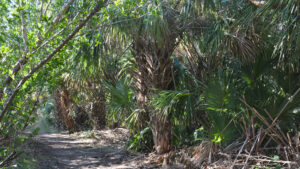
Bordering Indian River Lagoon Preserve State Park, Maritime Hammock Sanctuary showcases maritime, or coastal hammock, marshlands, and mangroves along the Indian River Lagoon.
It’s 150 acres preserved from the residential development that has otherwise spread up and down A1A through Melbourne Beach. “This is the place where the North meets the South” … biologically speaking.
 John walks past a big gumbo limbo in the tropical hammock
Resources





Disclosure: As authors and affiliates, we receive earnings when you buy through our links. This helps us provide public information on this website.
Overview
Location: Melbourne Shores
Length: 3.5 miles
Trailhead: 27.956304, -80.502777
Address: 6200 S Highway A1A, Melbourne Shores
Fees: Free
Restroom: None
Land manager: Brevard County
Phone: 321-723-3556
Open sunrise to sunset. Hiking only. No bicycles or pets permitted. Expect mosquitoes and use sun protection. Be alert for alligators along the many waterfronts of this preserve.
Directions
From Interstate 95, take exit 180 for Melbourne. Follow US 192 east 8 miles through downtown and continue over the causeway to Indialantic. When the highway ends at the beach, turn right and follow A1A for 10.3 miles, passing a variety of public beaches en route to the community of Melbourne Beach. Park at the north trailhead (you’ll have to pull across the bicycle path to do so, so watch for pedestrians and bicycles) and start your hike there.
Hike
Start your hike at the North Trailhead, where there are several grassy parking spaces on the slope above the bike path. Stop at the kiosk to pick up a map.
The preserve is shaped like a bridge, with an incursion of subdivision in the middle, although the houses are well hidden from view.
 North Trailhead
There used to be a nursery through this section. Most of the non-native plants have been removed.
A nice spill of almost ultraviolet morning glory blooms tumble over a fallen log. The trail is partially shaded by cabbage palms and live oaks.
 On the former nursery grounds
Wild coffee and marlberry grow in the understory as you pass a baffle along an old fenceline, entering a shady hammock. Resurrection fern carpets the oak limbs.
Sword ferns spill down the slope of an old canal. It may have been built to provide water to the nursery. The trail trends moderately downhill through a forest of tall, skinny marlberry.
 Marlberry
Loop uphill through a small scrubby area and under the shade of red bay and live oak trees with closely-knit limbs. Coral bean shows off its brilliant red blooms.
Snaking around the hill to descend it, the trail enters a lush hammock. The skunky smell in the air is white stopper, the “naked wood” of this hammock.
 Skinny white stopper trees on a curve
Look up into the high canopy for orchids, primarily butterfly and greenfly orchids, which bloom in the summer months. Even off-season their leaves are showy.
As the corridor narrows, tropical trees and shrubs crowd the understory. A natural archway rises over the trail; you may need to duck under it.
 Woodland archway
The trail twists and winds through the dense forest beneath tree limbs outstretched in graceful windswept arcs like ballet dancers.
Becoming mushy underfoot, the footpath reaches a series of bog bridges surrounded by giant leather ferns. Broadening, the trail meets a T intersection at a fenceline. Turn right.
 Crossing the fern bog
Cross a bridge past a bench and walk along a palm-lined creek. A side spur trail provides a shaded bench from which to look out and savor the view. Scan the waters for alligators.
At the trail junction, the “You are Here” marker provides a map to show where the trail system goes. Turn right to tackle the stacked loops on the north end of the sanctuary.
 Creek
The footpath is right behind the mangrove roots along the Indian River Lagoon. There are big holes beneath them where giant land crabs lurk, and smaller holes for fiddler crabs.
Crossing a bridge, the trail slips around a mound of oyster shells. Expect soggy spots when the tide is up.
 The lagoon is just behind the mangroves
Rise into a palm hammock with bog bridges and a more substantial bridge over a larger waterway choked with algae.
To the right is a large marsh full of giant leather ferns. The palms overhead make a constant rustling sound in the breeze off the lagoon.
 Bog bridges
A half mile in, encounter a large gumbo-limbo tree, jokingly called the “Tourist Tree” due to its distinctive red, peeling bark.
Another “You are Here” map marks the bottom of the next loop. Going right takes you uphill atop shard of clams and oysters under the leaf litter, most likely another midden.
 Trail junction
The footpath widens so it no longer seems like you’re elbowing your way though the forest.
Trees overhead are draped in bromeliads. Sprays of shoelace fern and goldfoot fern emerge from the tall cabbage palms. Southern woods fern grows to Jurassic sizes.
 Palm hammock
Winding past a stand of bamboo, re-enter the palm hammock. Roots jut prominently amid gooey spots, both conspiring to trip you up if you don’t look down. The earth is dark and rich.
Emerge at a beauty spot at the next trail junction, a panoramic view of open marshes framed by cabbage palms and giant sprays of sand cordgrass. Turn right to circle the marsh.
 Marsh Loop
Mounds of coreopsis and aster bloom throughout open areas. This is an excellent spot for birding. At a junction with a gate to the right, stay left.
Continue along a levee between two man-made marshes, where coots float in the nearshore reeds, fussing at each other.
 A pair of anhinga roosting at the marsh
A side trail leads to the adjoining neighborhood, where there is a kiosk and bike rack at this back entrance. Pass it by and continue along the marsh on your left.
To complete the upper loop, make a sharp left and cross a weir that allows tidal waters to flow in and out of these impoundments. Turn right to return on the west side of the loop.
 Savor sunset with a visit through the back gate
A mile in, the trail turns left and you’re along the lapping shoreline of the Indian River Lagoon. Here, the mangroves grow substantially taller.
A boardwalk leads through a wet area. Sea wrack and oyster shells are spread across open spots between the mangroves.
 Shoreline boardwalk
Walk through a palm hammock where young sea grapes, nickerbean, and morning glory spill through the understory.
A tall stand of white mangrove is between you and the lagoon, an interesting yellowish hue to their trunks. Complete the double upper loop, returning to the junction with a map.
Continue forward past the marsh filled with giant leather ferns and across the bridge to reach the initial junction at 1.8 miles.
 Waterway near the junction
The next portion of the trail isn’t as interesting as what you’ve hiked so far. It’s a necessary connector between the hammocks within this sanctuary, skirting the residential inholding.
It is a long walk along a tall levee next to the mangroves that line the Indian River Lagoon. Search for ibises in the mangrove limbs.
 Levee walk
A massive alligator lives at the base of one sharply banked turn in the levee, so don’t hike this piece on auto-pilot. A long straightaway leads to this left turn.
Reaching an interpretive sign about the impoundments, created for mosquito control many decades ago, watch for a bridge on the left at 2.4 miles.
 Lagoon behind the mangroves
This is a trail junction. Straight south the dike connects to the trails of adjoining Indian River Lagoon Preserve State Park.
Within this preserve, it’s your last place to look out over the Indian River Lagoon along the loop. Turn left and cross the bridge over the mangrove-lined canal.
 Looking back towards the lagoon
More shells are scattered on the dark ground beneath the tropical understory. There are many opportunities to trip over roots and hit your head on low hanging branches.
Benches are more frequent. Pass through a forest of young gumbo-limbo.
 Bench along a curve
Past an sign about the tropical plants, the air is infused with a damp, skunky aroma.
The young tropical trees are skinny, smooth-barked, and packed densely through this part of the forest, like the tropical hammocks of the Florida Keys.
 Tropical hammock with a lot of stopper
Branches curl into bizarre inchworm shapes overhead as the high canopy fills in with red bay and live oak again.
Past a bench and a boardwalk is another gooey section of footpath. Poison ivy crowds too close for comfort.
 Boardwalk
A spur trail leads right at 2.7 miles to an observation deck that opens up onto a lagoon.
Look around quickly to see the wading birds roosting and feeding in this hidden pond. The mosquitos are more intense here than along the rest of the loop.
 Pond
Turn around and continue into the hammock, where another bench provides a resting spot as the trail curves around a rather large red bay tree.
Shells crunch underfoot. Continue through the shade of the hammock past another bench.
 Bench under a red bay
At 2.9 miles, make a sharp left and join a corridor with a scrubby feel. Re-enter the dense tropical hammock, the trail twisting and winding.
Walk beneath oaks arching from left to right, undulating fingerlings of branches spreading to provide deep shade and shelter for more bromeliads and orchids.
 Oak archway
The footpath gets hilly, as if climbing up and over middens. The trail pops out under a power line. A marker ushers you to the right. Emerge onto the paved bicycle trail at 3.3 miles.
This is the South Trailhead. Turn left. Walk the paved trail past the Mark’s Landing inholding as traffic zips past along A1A. Reaching the North Trailhead, complete a 3.5 mile loop.
 South Trailhead
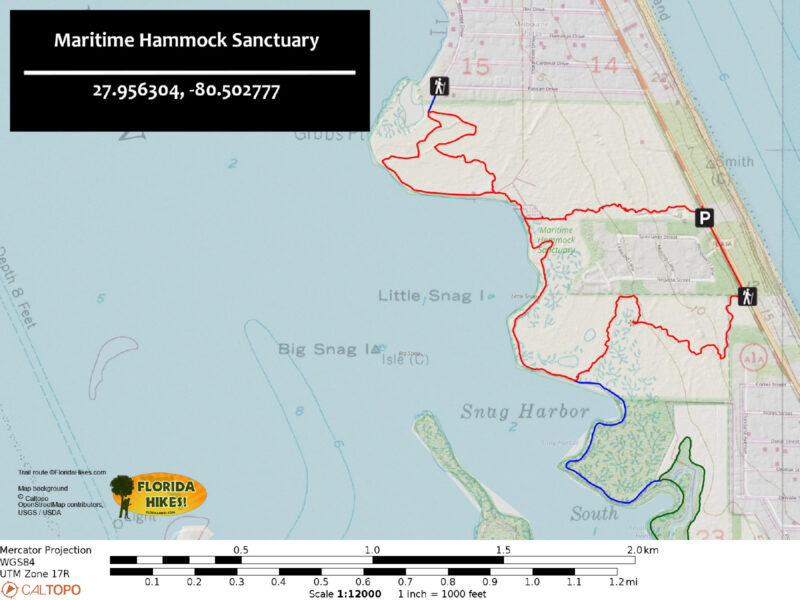
Trail Map
Explore More!
Slideshow
See our photos from Maritime Hammock Sanctuary
Nearby Adventures
 Indian River Lagoon Preserve State Park In a state park where the main goal is preservation and restoration, a wide dirt pathway leads to views of mangrove-lined shorelines along the Indian River Lagoon.
 Doc Ehrhart Sanctuary Home to a gentle mile loop through coastal habitats on the Barrier Island Trail, Doc Ehrhart Sanctuary is a gateway to Archie Carr National Wildlife Refuge.
 Archie Carr National Wildlife Refuge Stretching from Melbourne Beach to Sebastian, this refuge protects sea turtle nesting grounds along the Atlantic Ocean
 Coconut Point Sanctuary Call it the Ocean-to-Lagoon Hike: this 1 mile loop through one of Brevard County's most diverse natural lands connects the Atlantic Ocean and the Indian River Lagoon in Melbourne Beach

- Michael Crotty Bicentennial Park - November 3, 2026
- A.J. Henry Park - November 1, 2026
- Okeeheelee Nature Center Trails - October 22, 2026