
In 1944, World War II was raging, residents were rationing and buying war bonds, and soldiers poured through Naval Air Station Sanford for training.
Yet in that year the Levy family granted Seminole County 55 acres along the St. Johns River, a beautiful live oak hammock and waterfront as a public park.
 Boater access and dock
Their legacy provides boaters and paddlers access to a relatively remote curve of the river’s broad marshes between Lemon Bluff and Cameron Wight Park.
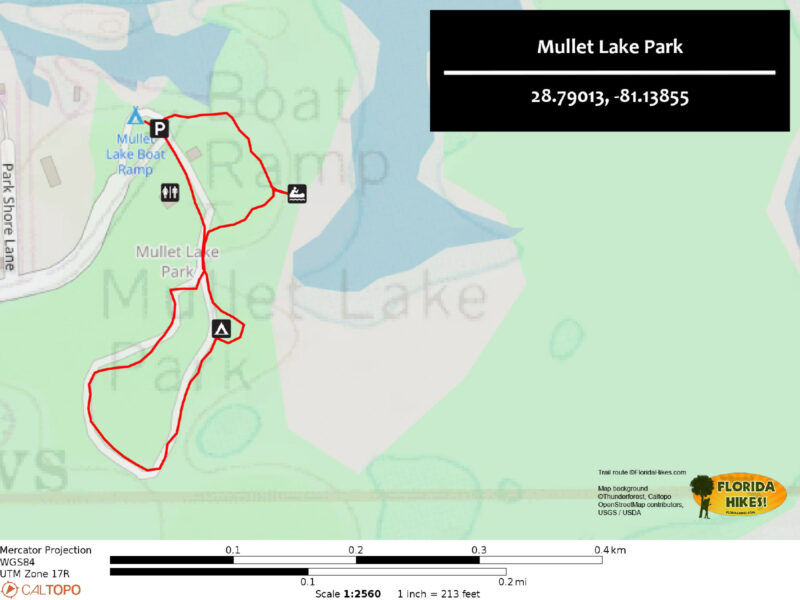
Ancient live oaks form the centerpiece of the hammock, shading a primitive campground. There are no established trails, but a full circuit of park and campground is less than a mile.
 Showy fall sunflowers
Resources





Disclosure: As authors and affiliates, we receive earnings when you buy through our links. This helps us provide public information on this website.
Overview
Location: Geneva
Length: 0.8 mile loop
Trailhead: 28.790182, -81.138667
Address: 2368 Mullet Lake Park Rd, Geneva
Fees: Free. Camping $15 per night per site up to 6 people.
Restroom: Adjoining the parking area
Land manager: Seminole County
Phone: 407-665-2180
Open 8 AM to dusk unless camping. Boat ramp open 24 hours. Pets prohibited. Camping requires a permit. Sites are walk-in. Call to arrange.
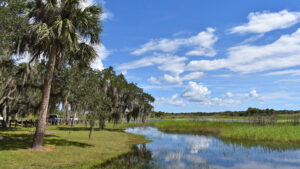
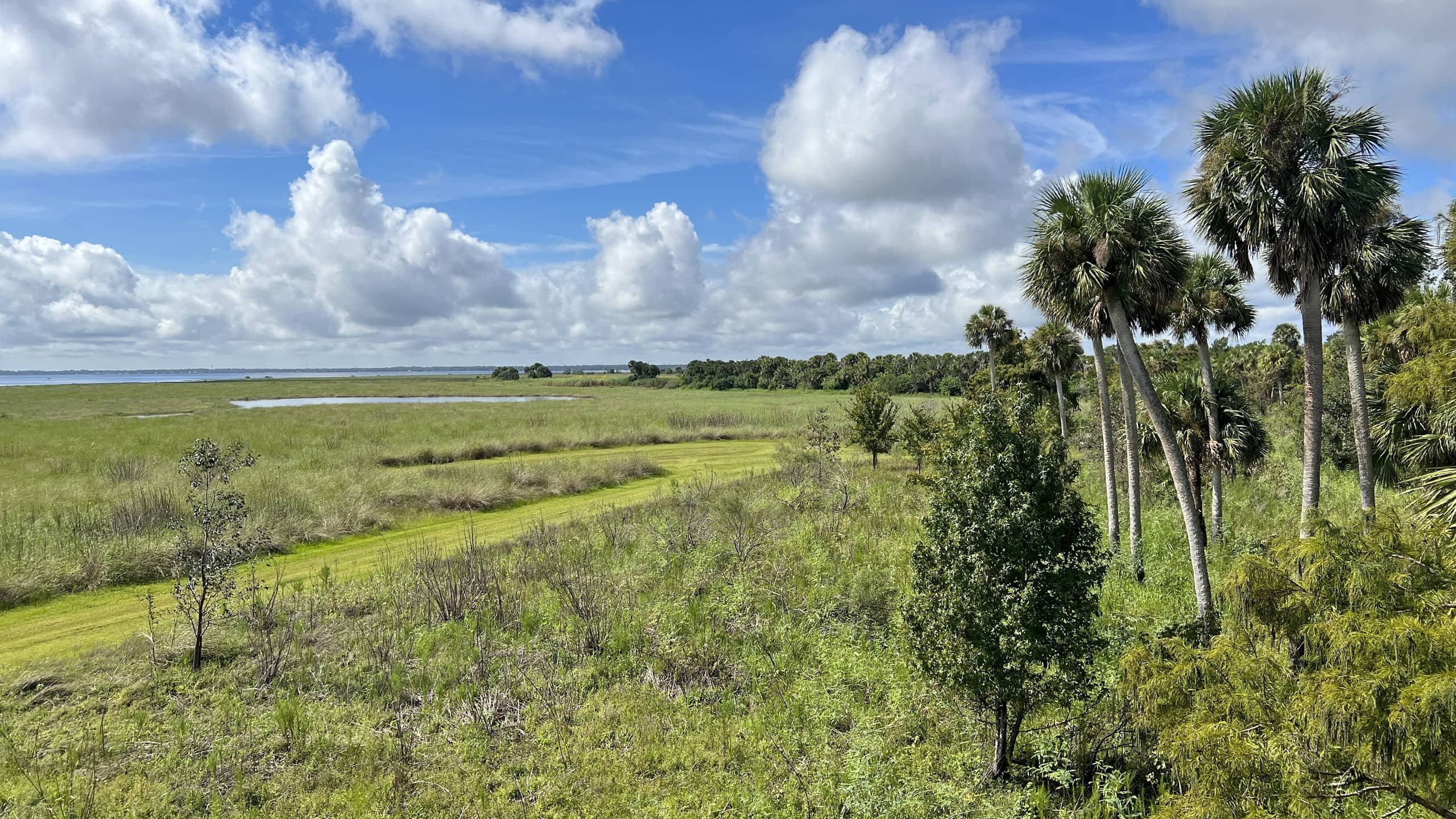
Located in a low-lying peninsula along a marshy portion of the St. Johns River, Mullet Lake Park floods when the river rises. Note the watermarks on the trees.
Don’t try to reach the park if water is lapping at the paved road on the way there.
Directions
Follow SR 46 east from Sanford. Crossing the St. Johns River at Lake Jesup 2.8 miles east of the traffic light at Lake Mary Blvd, take the turnoff on the left immediately after the bridge. Follow Osceola Rd for 1.4 miles to Mullet Lake Park Rd. Turn left. This narrow road makes several sharp turns over the next 1.9 miles and ends by entering the park. A parking circle adjoining the boat ramp. Secondary parking is under the oaks past the restrooms.
About the Park
A boat ramp and dock dominate the waterfront as you drive in. But there’s much more to the park than most visitors realize.
We first came to Mullet Lake Park curious what was at the end of the road, and stayed for the birds, settling onto a waterfront bench to watch the show.
 Boater headed for Mullet Lake
Egrets, herons, and ibis picked their way along the marsh adjoining the boat ramp, while red-winged blackbirds flitted among tall grasses.
A walk along the posts keeping airboats out of the oak hammock revealed more bird life, particularly above the broad wetland where airboats launch.
 Great egret
Roseate spoonbills shuffled through the muddy flats, while great blue herons nabbed fish from drying pools.
Sandhill cranes stalked the grassy shoreline along a swale of marsh between a shaded parking area and the campground.
 Roseate spoonbill
Swallow-tailed kites, wood storks, and bald eagles soared over the marsh.
Red-cockaded woodpeckers and flickers climbed the trunks of the stately live oaks. A red-shouldered hawk defended its nest with shrill cries.
 Swallow-tailed kite
A rare find in the Orlando metro, this park has a walk-in primitive campground with eight tent sites under the grandfather oaks.
Each site has a graveled pad and a sand pad for pitching a tent. The largest one, site 8, is a group site with multiple pads.
 Entering the campground
Adjoined by a barbecue grill and fire pit, a picnic table sits on a concrete slab in-between. As bears roam Seminole County, a bearproof trash can is provided.
The sites just inside the campground gate have the best view of the marsh for birders and are closest to the restrooms.
 Site 4
Even if you’re not camping, the unpaved loop road through the campground makes for a pleasant walk with more opportunities for birding and botanizing.
In the summer months, butterfly orchids bob from the hanging gardens of ferns on the live oak limbs high overhead.
 Live oak canopy above Site 8
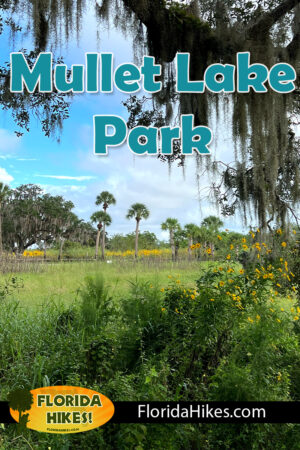
In September, swamp and narrow-leaf sunflowers unfurl in all their glory, fringing the river basin in a yellow glow.
They provide a beautiful backdrop to the campsites nearest the start of the loop.
 Marsh view from Site 4
The showiest and tallest sunflowers line the posts between the airboat launch and the waterfront with the boat ramp.
Blooms vary by year, depending on seasonal rainfall, and typically fade by mid-October.
 Sunflowers along the posts
Trail Map
Explore More!
Video
A walk through Mullet Lake Park
Slideshow
See our photos from this park
Nearby Adventures
 Lake Harney Wilderness Area With an outstanding accessible observation tower offering a panorama of the St. Johns River floodplain, Lake Harney Wilderness is a must-see for birders and photographers.
 Geneva Wilderness Area Showcasing prairie ponds amid scrub on the edge of a pine flatwoods, Geneva Wilderness Area offers two loops of gentle paths on which to explore the habitats.
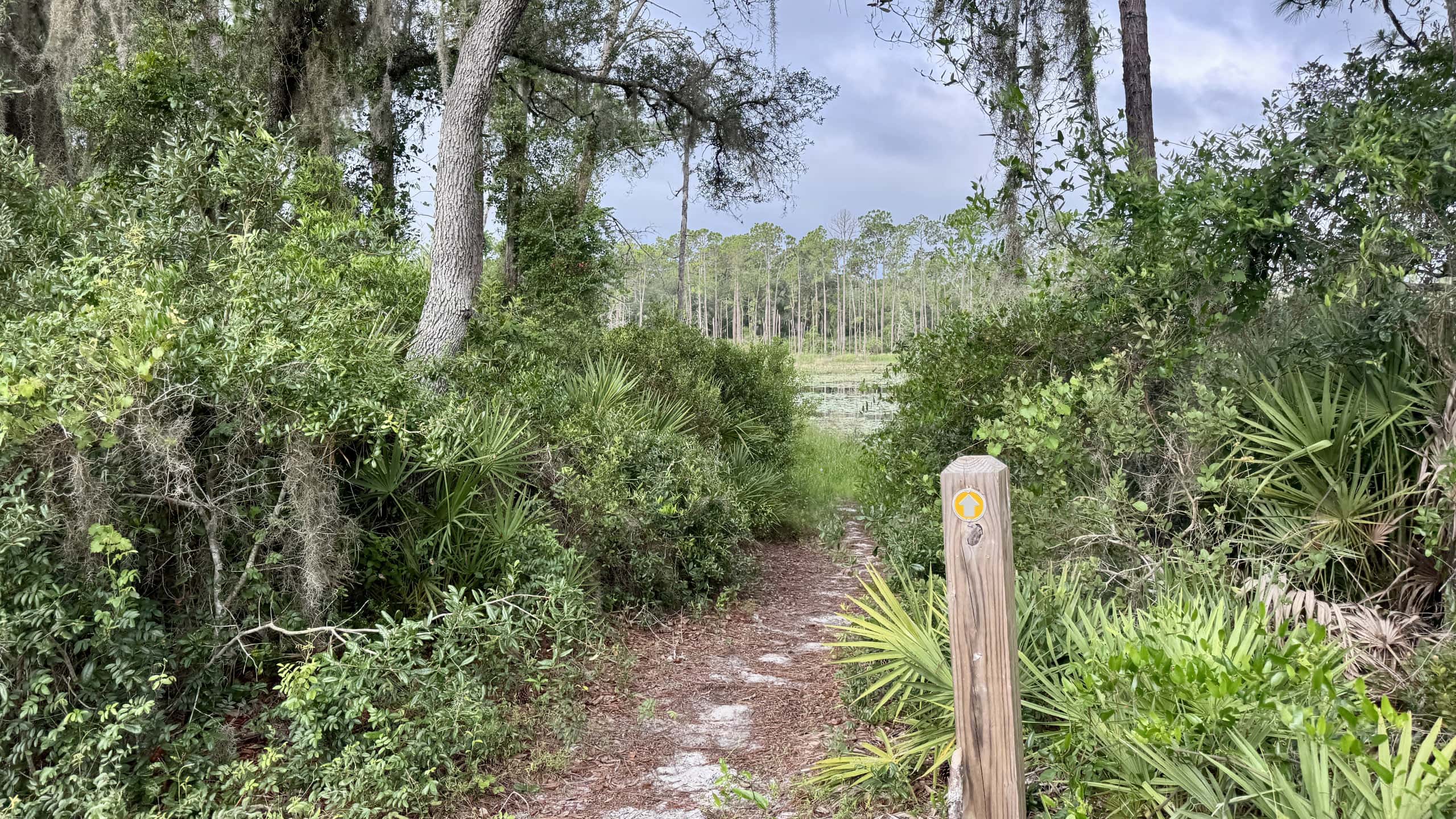 Lake Proctor Wilderness Area Protecting 475 acres of of marshes, prairie, sandhill, and scrub, Lake Proctor Wilderness Area echoes with the cries of sandhill cranes across the landscape.
 Lake Monroe Conservation Area With marshes brimming with swamp sunflowers and old-growth forests along natural ridges, Lake Monroe Conservation Area protects the St. Johns River north shore at Osteen

- Hal Scott Red Trail - November 13, 2026
- Baseline Trails - November 7, 2026
- Hal Scott Yellow Trail - November 3, 2026