
A significant karst feature along the St. Marks River, Natural Bridge is, literally, a natural bridge. The river vanishes underground, reappearing within view.
Strategically important to the defense of Tallahassee during the Civil War, it was the site of the state’s second largest battle between Confederate defenders and Union troops.
 A memorial to the defenders
Consecrated as a battlefield memorial in the years following the Civil War, this is also a very scenic spot.
Acquisition of additional lands in the river basin means an expansion of recreation beyond the area around the riversink and its rise to the south.
 St. Marks Riversink
Resources





Disclosure: As authors and affiliates, we receive earnings when you buy these through our links. This helps us provide public information on this website.
Overview
Location: Woodville
Trailhead: 30.285086,-84.153603
Address: 7502 Natural Bridge Rd, Tallahassee
Fees: $3 per vehicle, $2 cyclist or pedestrian
Restroom: Yes
Land manager: Florida State Parks
Phone: 850-487-7989
Open 8 AM to sunset. Leashed dogs welcome. Picnic tables are provided. Fishing permitted.
Guided interpretive tours of the park are available. Call two weeks in advance of your visit to arrange.
Directions
From the intersection of Capital Circle East and Woodville Hwy (SR 363) in Tallahassee, drive south past the northern terminus of the St. Marks Historic Railroad Trail and continue 4.5 miles to Woodville. Turn left on Natural Bridge Rd and continue east 6 miles to the park entrance. From Newport along US 98, Old Plank Rd north 6.6 miles is the most direct route to the park but it isn’t paved. Use SR 267 (Bloxham Cutoff) to Woodville Hwy and continue north to Woodville to take Natural Bridge Rd east.
About the Park
The park’s original purpose was to honor the fallen of Florida’s second largest Civil War battle, which occurred late in the war in the defense of Tallahassee.
Union troops landed along the shoreline within sight of the St. Marks Lighthouse, intending to march on the state capital to force an overall surrender.
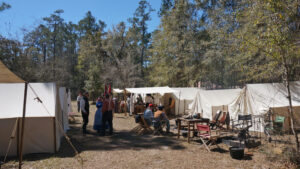
 Union encampment during a re-enactment
On March 6, 1865, the Union troops met a home guard made up of the Florida 5th Cavalry and cadets from the West Florida Seminary, now Florida State University.
These Confederate soldiers, largely old men and young schoolboys, repelled the Union advance in a battle in these woods.
 Examples of breastworks
They are credited with keeping Tallahassee the only Confederate state capital east of the Mississippi River that did not fall into Union hands during the war.
Some historians surmise that the Union objective was to capture the key port of St. Marks rather than invade Tallahassee, thus they came to this spot to utilize the Natural Bridge.
 The river is visible in the bottom of sinkholes south of the riversink
If so, their objective would have been Fort Ward, at the confluence of the St. Marks and Wakulla Rivers, now San Marcos de Apalache Historic State Park.
With encampments representing both sides and a full array of sutlers selling wares, a battle re-enactment is held in this park the first full weekend of March.
 Several hundred participants represent both sides of the battle
Geology
Rising from the marshy floodplain of Lake Lafayette in Tallahassee, the St. Marks dives underground in a river sink more than once in these woods, similar to the Aucilla River to its east.
At this particular location, a road was built across the natural bridge. Facing east, the river sink swallet is on your left, part of the expansive pool.
 At times duckweed covers the surface
The river is then visible in a series of sinkholes before it emerges less than a quarter mile south as the St. Marks River Rise Spring.
At that point, it becomes broad enough for boaters to navigate. It continues its flow towards St. Marks, meeting the Wakulla River at a confluence.
 Confluence of the St. Marks River and Wakulla River at San Marcos de Apalachee
Trails
This state park had no trails until 2023. In the late 2010s, acquisition of lands along the St. Marks River helped to protect many springs along its length. Now you can visit one.
 Horn Spring Trail Four miles upriver from Natural Bridge Battlefield as the trail winds, scenic Horn Spring is a destination within an expansion of the park protecting springs of the St. Marks River.
It’s an 8 mile round-trip hike to Horn Spring. You can also paddle upriver to see it via a launch on the other side of the Natural Bridge along Natural Bridge Rd.
 The St. Marks River at Natural Bridge Battlefield
Trail Map

Explore More!
Slideshow
See our photos of Natural Bridge Battlefield
Video
Hiking the Horn Spring Trail
Nearby Adventures
 San Marcos de Apalache Historic State Park With a historic timeline dating back five centuries, San Marcos de Apalache protects layers of history accumulated at the confluence of the Wakulla and St. Marks Rivers
 Wakulla Springs State Park A 1930s resort turned nature park surrounding one of the world's largest springs, Wakulla Springs State Park is a step back in time with a historic waterfront lodge.
 Wakulla State Forest Forest roads and multi-use trails form a loop in Wakulla State Forest, navigating a variety of natural environments including a small freshwater spring.
 Florida Trail, Aucilla Sinks 4.4 miles. Winding through a geologically weird and archaeologically significant part of Florida, the most fascinating segment of the Florida Trail is the Aucilla Sinks

- Hal Scott Yellow Trail - November 3, 2026
- Hal Scott Preserve - October 28, 2026
- Tradewinds Park - October 27, 2026