
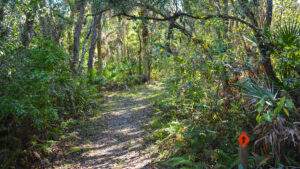
Protecting more than 26,000 acres, Florida Panther National Wildlife Refuge is part of a larger landscape-level effort of habitat conservation for this native species.
The panther’s population fell drastically as the old-growth forests of Southeast Florida were cut down and converted to ranches, farms, and orange groves.
 Mixed forests like these were cleared for agriculture
Not protected by law until 1958, the panther was shot as a “varmint” for stealing cattle.
In 1981, the first efforts to define and manage Florida’s panther population began. The refuge was established in 1989 contiguous with other public lands the panther roamed.
By the 1990s, roughly fifty panthers remained. Inbreeding was a problem. Introduction of eight female Texas pumas helped prevent extinction.
While rebounding, the Florida panther population is still endangered due to ongoing destruction of its natural habitat for development and its need for large territories.
 You are more likely to see a panther at a wildlife center like Homosassa Springs Wildlife State Park than to see one in the wild
On this 1.3 mile loop, the Panther Trail introduces the natural habitats the big cat requires for survival.
Herds of deer and wild turkey roam the prairies and pine flatwoods, providing sustinence for Florida’s apex predator.
 A mix of open prairie and hammocks is key to this landscape
Resources





Disclosure: As authors and affiliates, we receive earnings when you buy through our links. This helps us provide public information on this website.
Overview
Location: Immokalee
Length: 1.3 mile loop
Trailhead: 26.16173, -81.34627
Address: 12085 SR 29, Immokalee
Fees: Free
Restroom: Privy at trailhead
Land manager: US Fish & Wildlife Service
Phone: 239-657-8001
Open sunrise to sunset. No pets permitted. If the gates along SR 29 are locked, the refuge is closed for land management activities.

In the unlikely event you encounter a panther, it will probably run off. If it doesn’t, the refuge advises do not run or crouch or stoop. Face the cat and look as large as possible.
Back up if need be to give it space to escape. To drive it off, throw whatever you can reach without stooping down. If it acts aggressively, fight back.
Directions
From Interstate 75 exit 80 east of Naples, take SR 29 north. The refuge entrance is immediately on the left. Follow the limerock road to the parking area within the gates.
Hike
Passing through the gate marked “Leslie Duncan Memorial Trail” behind the kiosk, keep left where the trail splits.
Markers start out in both blue and red as the trail enters a hammock with outcroppings of limestone in the forest floor.
 Memorial stone
A tenth of a mile in is the turnoff where the Panther Trail peels off the graded limestone path. Turn left and start down the leafy corridor.
Expect soggy shoes along this hike. Your feet won’t stay dry unless the entire swamp is dry, which does happen some seasons in winter and early spring.
 Ferns grow profusely in the damp forest floor
After a sharp turn, descend through a lush oak hammock before the trail opens up onto a wet prairie.
The buzz of traffic on Interstate 75 grows with a glimpse of the road and of power lines. Be cautious of the sticky marl mud in this prairie, easy to slip on.
 In the open prairie
Pass some scattered limestone boulders before looping around a solution pond.
Be cautious of solution holes – natural deep holes in the limestone bedrock – throughout the prairie. They are often hidden by the grass.
 Slab of limestone bedrock
After a sharp right, the trail winds left and skirts a solution hole. At the half mile mark, reach the zone where flatwoods and prairie meet.
This is one of the best spots to look for wildflowers, especially terrestrial orchids.
 Hiking towards the pine flatwoods
Enjoy a brief dry spot in the pine and palm uplands before slogging across a slough.
Cross an oak hammock that forms an island in the swamp. Look for bromeliads and orchids in the trees.
 Bromeliad
At 1 mile, the trail makes a hard left along a line of cabbage palms before winding through a lush tropical hammock for another quarter mile.
Reach a different gate than the one you entered. Open it and exit to the clearing, finishing the loop in front of the trailhead kiosk.
 Hammock at the end of the hike
Trail Map

Explore More!
Learn more about Florida Panther National Wildlife Refuge
 Florida Panther National Wildlife Refuge Explore the habitat of Florida's apex predator on a pair of short hiking trails in one small corner of the vast territory that the endangered Florida panther roams.
Slideshow
See our photos from the refuge
Nearby Adventures
 Leslie M. Duncan Memorial Trail Try a tiny sample of the vast mosaic of habitats within the 26,000-acre Florida Panther National Wildlife Refuge on this short accessible-with-assistance loop.
 Dr. Robert H Gore III Preserve In a lesser-known corner of the Big Cypress Swamp, Dr. Robert H Gore III Preserve immerses hikers in truly wild South Florida landscapes on its nature trails.
 Fakahatchee Strand Preserve State Park It’s the Amazon of North America, home of the ghost orchid. Protecting more than 85,000 acres, Fakahatchee Strand is Florida's largest state preserve and most certainly our wildest.
 Big Cypress National Preserve Protecting nearly three quarters of the million-acre Big Cypress Swamp, Big Cypress National Preserve is Florida's second largest and most remote wilderness.

- Hal Scott Yellow Trail - November 3, 2026
- Hal Scott Preserve - October 28, 2026
- Tradewinds Park - October 27, 2026