

Named after a legend of a local who became lost in these foreboding woods, Tate’s Hell is one of Florida’s largest state forests.
It encompasses over 200,000 acres within sight of the salty waters of the Forgotten Coast, accessed via US 98.
 Following the West Loop into the scrub
The High Bluff Coastal Hiking Trail parallels the waterfront through relict dunes topped with scrub plants like Florida rosemary and scrub mint.
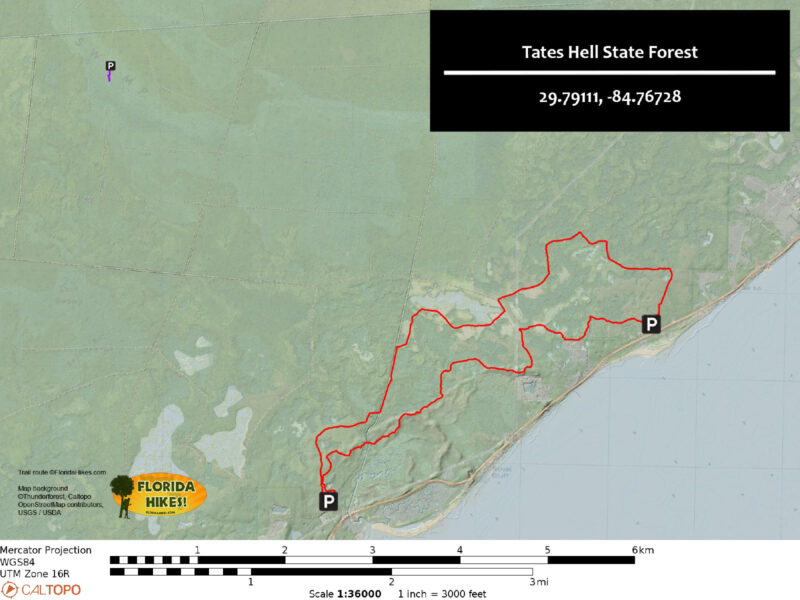
It combines two loops with a trailhead at each end. Each of these well-blazed trails can be hiked separately or together as one long loop.
 Walking through a rosemary scrub
Resources





Disclosure: As authors and affiliates, we receive earnings when you buy through our links. This helps us provide public information on this website.
Overview
Location: Carrabelle
Length: 8.9 miles
Trailhead: 29.791111, -84.767278
Address: 2381 West US 98, Carrabelle
Fees: $2 per vehicle
Restrooms: None
Land manager: Florida Forest Service
Phone: 850-697-0010
Open sunrise to sunset. Leashed dogs welcome. Seasonal hunting occurs throughout this forest. Check ahead before you make plans for outdoor recreation.
Directions
From the intersection of US 98 and Tallahassee St. in downtown Carrabelle, head east on US 98. Continue on US 98, passing the East Trailhead on the right before continuing for another 3.3 miles to the West Trailhead and turning onto a dirt road. Follow the dirt road for 0.2 mile to a parking area at the end.
Hike
At the northeast end of the parking area, a covered kiosk provides paper maps and information about the forest.
Passing through a gap in a wooden fence marked with two orange blazes, follow the narrow trail leading through a shady stand of sand pines.
 West trailhead
Shade doesn’t last long on the winding West Loop as the trail quickly opens to a scrubby flatwoods peppered with a mix of pines and an understory of dense brush.
Scrub oaks and lyonia border a corridor of bleached white sands alongside small clusters of false rosemary, lupine, and sand spikemoss.
 Unique scrub vegetation
Reaching 0.8 mile, the trail crosses a canal that passes though a salt marsh to the south before emptying into nearby Saint George Sound.
A picnic table sits on a sandy hill next to a metal pedestrian bridge spanning the brackish waterway.
 Canal bridge
In a slow ascent of ancient sand dunes, large bunches of Florida rosemary become prevalent alongside the trail, filling the air with pungent aromas.
Deer moss and gopher apples carpet open areas between a variety of shrubs displaying an impressive palette of green hues.
 Florida rosemary in the scrub
Continuing east, the trail dips into lower areas while crossing a mixture of basin swamps and mesic flatwoods.
A series of boardwalks cross wetland areas, although stretches of the trail may experience seasonal flooding based on recent rain patterns.
 Swamp titi in the wet flatwoods
At 2.8 miles, orange blazes end where the East Loop begins. A cross trail splits through the middle, separating the two loops.
Following blue blazes onward, traverse a rollercoaster of dry scrubby flatwoods and wetlands, passing a small side loop before reaching the East trailhead at the four mile mark.
 East trailhead
Directly to the east of the trailhead, blazes lead through a slough with potential for some of the deepest water on the trail.
This small section can be avoided by following a sandy forest road that curves to the northeast before meeting the trail again in a quarter mile.
 Trail through slough next to the East Trailhead
As the trail winds around to the north end of the East Loop, the path primarily follows wide, grassy access roads cutting through mesic flatwood habitats.
Several small boardwalks circumnavigate depressions in the road that are typically filled with water.
 Boardwalk bench
Joining the West Loop again at 6.3 miles, orange blazes lead through patches historically used as pine farms.
Some are undergoing restoration efforts to return the ecosystem to a more natural state.
Following a sweeping curve at the western end of the loop, the trail encounters one final dip that may hold deep water.
Hikers can avoid this puddle by hopping over to an adjacent section near the beginning of the trail and following orange blazes for 0.2 mile to the trailhead.
 Pine plantation under restoration
Trail Map
Explore More!
Learn more about Tate’s Hell State Forest.
 Tates Hell State Forest One of Florida's more enormous state forests with over 202,000 acres, Tate's Hell is a vast coastal swamp sliced and diced by timber barons before being preserved by the state.
Video
A walk through the High Bluff Coastal Hiking Trail
Nearby Adventures
 Ralph G. Kendrick Dwarf Cypress Boardwalk Leading to a stand of dwarf bald cypress centuries old and less than 15 feet tall, the Kendrick Boardwalk at Tate's Hell State Forest is one of the weirder botanical spots in the Florida Panhandle.
 Fort Gadsden At Fort Gadsden Historic Site, a gentle walk in the Apalachicola National Forest leads through the well-interpreted historic site and a pine forest where wildflowers thrive.
 Florida Trail, Jewel to Vilas 14.3 miles. Delving deep into the swampy heart of the Apalachicola National Forest, this section spans some of the gnarliest titi and gum swamps you'll see outside of Bradwell Bay.
 Florida Trail, Porter Lake to Jewel 4.6 miles. A deep immersion in pine flatwoods and titi swamps awaits along this segment of the Florida Trail, which uses many old forest roads to cross tributaries draining into the Ochlockonee River.
- McCarty Ranch Preserve - April 13, 2026
- Bullfrog Creek WEA - April 7, 2026
- Ney Landrum State Park - April 3, 2026