
Originally named Jungle Park, this rare parcel of preserved hardwood hammock was once planted with non-native flora before a major hurricane tore through in 1926.
After the storm, botanist Charles Torrey Simpson shared his knowledge of native plants to assist in repopulating the park with native vegetation.
In 1931, the park’s name was changed to pay homage to Simpson’s dedication. He spent many years living in the area, documenting now-rare South Florida flora.
 Historic marker
The garden club building, which serves as a visitor center, was constructed in 1941. Parking is limited in Miami, and the center has a couple of free spots out front for guests.
The park has two entrances, one by walking through the garden club building, and another at the corner of SW 15th Rd and S Miami Ave.
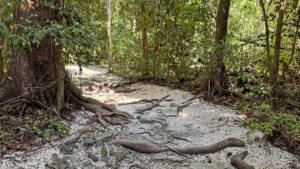
Inside the park, a network of rugged crushed shell pathways winds through the hammock, passing dozens of plant identification signs along the way.
 Visitor center
Resources





Disclosure: As authors and affiliates, we receive earnings when you buy through our links. This helps us provide public information on this website.
Overview
Location: Miami
Length: 0.5 miles
Trailhead: 25.758139, -80.197083
Address: 55 SW 17th Rd, Miami
Fees: Free
Restrooms: At visitor center
Land manager: City of Miami
Phone: 305-533-3577
Open 8 AM to 3 PM. No pets allowed.
Directions
From the intersection of SW 4th Ave and SW 7th St next to Interstate 95 in downtown Miami, head south on SW 4th Ave for 0.3 mile, before turning left onto SW 15th Rd. In 0.4 mile, take the first right at the traffic circle, continuing on S Miami Ave for 0.2 mile before turning right onto SW 17th Rd, and the parking area will be immediately on the right.
Hike
Starting at the garden club, step off the back porch onto the trail and veer to the right, meandering over snakelike roots and chunks of exposed limestone.
A dense green jungle flanks the path, arching overhead to cast ample shade onto the rocky corridor.
 Exposed limestone
Gumbo limbo trees with their distinctive peeling bark stand alongside a variety of understory shrubs and vines, as signs indicate the direction of the trail.
Stay to the right at a couple of upcoming trail junctions to follow a course that ends at the northeastern entrance to the park.
 Northeast entrance
Turning back towards the garden club while keeping to the right, head down the north side of the loop. Signs identify native plants along the way.
Nicknamed after the park’s namesake, bushy Simpson’s stoppers border the trail, sporting fuzzy white fragrant flowers.
 Interpretive signage
As the trail ventures to the northwestern quadrant of the park, it opens to a quaint koi pond surrounded by several benches.
Follow the path as it rounds past the pond to weave through patches of ferns, wild coffee, and Florida bitterbush.
 Koi pond
The trail takes a final jog through the hammock, over gnarled roots and past a few more benches before returning to the garden club.
Before leaving, take a moment to admire a large paradise tree behind the building designated as a National Champion tree.
It is the largest known example of its species in the country.
 Trailside benches
Trail Map

Explore More!
Video
Hiking Simpson Rockland Hammock Preserve Park
Nearby Adventures
 The Barnacle Historic State Park In 1891, Commodore Ralph Middleton Munroe built his cherished retreat, The Barnacle, in the dense jungle of the Miami Hammock. The Barnacle Historic State Park preserves that sliver of history in Coconut Grove.
 Pinecrest Gardens Established in the 1930s as a tropical tourist attraction, Parrot Jungle, this tropical forest in Pinecrest has deep roots, if you will, showcasing both native and exotic tropical species.
 The Deering Estate The Deering Estate at Cutler, a Miami-Dade county park, preserves both the historic buildings and a remnant of the Addison Hammock, a pine rockland along the old road following Cutler Ridge.
 Fairchild Tropical Botanic Garden Established in 1938 as one of the world’s largest collections of tropical plants, Fairchild Tropical Botanic Garden is an integral part of the history of Florida botany and of Coral Gables.

- Calusa Heritage Trail - November 5, 2026
- Scherer Thaxton Preserve - October 21, 2026
- Little Awesome Preserve - October 19, 2026