
Resources




Disclosure: As authors and affiliates, we receive earnings when you buy these through our links. This helps us provide public information on this website.
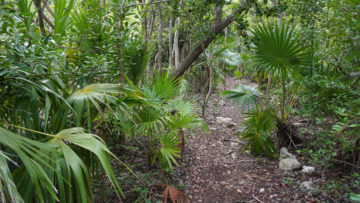
One of the delights of outdoor recreation in Florida are the tropical forests – we call them tropical hammocks – that grace our coastline from the central part of the state south into the Florida Keys.
Florida is the only place you can hike, bike, or paddle through a tropical forest in the continental United States.
Many of the trees you find in these forests have their origins from Caribbean islands. In fact, the forests of the Florida Keys look identical to those you’ll find in the Bahamas.
Because of the persistent humidity found in the strand swamps of Southwest Florida, certain orchids and bromeliads are found that won’t be seen elsewhere in the United States, such as the ghost orchid and Guzmania.
Jagged limestone karst found throughout Southeast Florida hosts upland tropical forests that look like a wall of trees in places. It’s on smooth-barked trees in these forests that our endangered Liguus tree snails can be seen.
Know Before You Go
You shouldn’t go off-trail in a tropical forest, since there are two very toxic species of tropical trees in Florida that you need to be on the lookout for: the poisonwood and the manchineel.
They are dangerous just to brush against, and their fruit can be deadly to humans, although it sustains the endangered white-crowned pigeon found in the Florida Keys.
 Florida’s Toxic Trees Southeast Florida is home to two poisonous trees, the poisonwood and the manchineel. Learn how to recognize them so you don't get too close, and find out how truly dangerous they are.
The trees and shrubs found in Florida’s tropical forests are generally unlike those found in any other habitats in Florida.
They include some of the heaviest, densest woods known on earth – including ironwood and lignum vitae – as well as a host of tropical plums (which include the deadly ones mentioned above) and shrubs that are tolerant to salt and heat.
 Florida Plants and Trees Florida's botanical bounty means a million shades of green. Here are photos and descriptions to help you identify plants, shrubs, grasses, mosses, and trees in Florida.
Best Tropical Hikes in Florida
These are among the best places to immerse yourself in a tropical forest in Florida.
 Arch Creek Park An oasis of natural tropical hammock in North Miami, Arch Creek Park hugs the eastern edge of its namesake creek, which once had a natural limestone bridge used by indigenous peoples and pioneers.
 Castellow Hammock Preserve Burrow into Florida's geological and cultural past on this short but rugged hike on an ancient rocky island once surrounded by the Everglades in The Redland.
 Collier-Seminole Hiking Trail A wet and wild 6.5-mile loop into the watery wilderness of the Big Cypress Swamp, the Collier-Seminole Hiking Trail provides a challenging wade into beauty.
 Crane Point Hammock Part native, part cultivated, Crane Point Hammock is 63 acres of tropical hammock in the heart of Marathon, with one of the most extensive trail networks in the Florida Keys.
 Curry Hammock Nature Trail An immersion into a tropical rockland hammock thick with rare Florida thatch palms, this rugged path leads to a bench overlooking the placid waters of Florida Bay.
 Dagny Johnson Key Largo Hammock Botanical State Park A botanical treasure rescued from developers, Dagny Johnson Key Largo Hammock Botanical State Park has the highest concentration of National Champion trees in the United States
 Fakahatchee Strand Preserve State Park It’s the Amazon of North America, home of the ghost orchid. Protecting more than 85,000 acres, Fakahatchee Strand is Florida's largest state preserve and most certainly our wildest.
 Fern Forest Nature Center A bounty of ferns awaits where three miles of trails introduce you to a slice of Florida’s past, a tropical forest surrounding the original floodplain of Cypress Creek near Fort Lauderdale.
 Grassy Waters Hog Hammock Trail At the north end of Grassy Waters Preserve, traverse an Ice Age ridge protruding above the sheet flow of Loxahatchee Slough on a series of islands topped with tropical hammock.
 Green Turtle Hammock Nature Preserve On a wild sliver of Upper Matecumbe Key, footpaths wind through a rockland tropical hammock where a rocky crevice emits sulfur fumes and signs warn of crocodiles.
 Gumbo Limbo Trail At Royal Palm Hammock in Everglades National Park, the Gumbo Limbo Trail is a gentle paved path that gets you up close and personal with a tropical hammock and its oolite holes.
 Key West Tropical Forest & Botanical Garden Boardwalks and footpaths wind through curated plant collections against a backdrop of natural habitats at the Key West Tropical Forest & Botanical Garden.
 Lignumvitae Key Botanical State Park Wrapped in a dense blanket of mosquitoes, Lignumvitae Key Botanical State Park is one of the United States' most significant botanical treasures, a virgin tropical forest home to more than a thousand lignum vitae trees.
 MacArthur Beach Satinleaf Trail Before you head out to the beach at John D. MacArthur Beach State Park, a quick stroll down the Satinleaf Trail will get you oriented to the tropical habitats that this park protects on Singer Island
 Mahogany Hammock Trail Mahogany Hammock is a tree island, a tropical oasis in the Everglades “river of grass,” where the short boardwalk trail immerses you in the jungle-like hammock.
 Matheson Hammock Trails One of the wilder places showcasing a remaining piece of the ancient Miami Hammock, the Hammock Trails at Matheson Hammock Park immerses you in a tropical forest.
 Pinelands Trail The Pinelands Trail is a showcase for South Florida’s weird and wonderful karst, a limestone bedrock that’s full of Swiss-cheese like holes, in a tropical forest where colorful tree snails make their home.
 Roberts Lake Trail 8.2 miles. Now the Roberts Lake Trail, the former Loop Road to Oasis section of the Florida Trail is now blazed blue. It is where sawgrass and cypress meet, where the Everglades and Big Cypress blend.
 Royal Palm Hammock Nature Trail Not quite a mile long, this intriguing nature trail explores a gradient of habitats from tropical hammock to salt marsh and mangrove forest.
 South Fork Nature Trail Along one of the Treasure Coast's most scenic waterways, the South Fork Nature Trail shows off the best side of the South Fork of the St. Lucie River.