
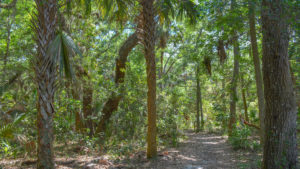
Built by Florida Trail Association volunteers more than four decades ago, the Bella Vista Trail lies immediately north of the park’s historical gardens.
A separate trailhead enables immediate access to the loop, or use the main parking area to enjoy a ramble through the formal gardens first.
 Along the old Jungle Road
It’s an immersion into a cross-section of habitats on the narrow high ground of this slender barrier island.
At both ends, the loop crosses a central spine of old A1A, constructed in 1926, abandoned in 1955 at the request of landowner Owen D. Young.
Chairman of General Electric, he and his wife settled into the small home now serving as a museum near the river, crafting these gardens in retirement.
 A view of the Matanzas River
Resources




Disclosure: As authors and affiliates, we receive earnings when you buy through our links. This helps us provide public information on this website.
Overview
Location: Hammock
Length: 1.9 miles
Trailhead: 29.632822, -81.208246
Address: 6400 N Oceanshore Blvd, Palm Coast
Fees: $5 per vehicle
Restroom: Portable toilet at trailhead
Land Manager: Florida State Parks
Phone: 386-446-6780
Open 8 AM to sunset. Leashed dogs welcome; pick up after your pet. Trail open to cyclists. Take precautions for mosquitoes and ticks.
Directions
The park is along the west side of A1A south of Marineland, 4.1 miles north of the Hammock Dunes Bridge at Palm Coast. After the entrance road makes a sharp left onto the straightaway of Old A1A, make a right into the dirt parking area for the Bella Vista Trail.
Hike
Starting north from the small parking area, check the kiosk. A map is posted and there may be maps in the box.
Follow the blue blaze and hiker symbol sign due north on a broad footpath into the coastal hammock.
 Trailhead kiosk
Reaching a trail junction with a double blue blaze and an FT sign, turn left to start the loop.
The FT sign denotes this path as part of the Florida Trail System. Occasionally blazed in orange, the west side of the loop is called the Jungle Road Trail.
 FT sign junction
On broad but gentle meanders through the palms and oaks, pass beds of ferns and tangles of grapevines. Reaching a Nature Trail sign, turn right.
Now the trail feels like a road, and indeed was a north-south route through this hammock, probably prior to A1A being built.
 Nature Trail sign
It is very evocative of what the earliest wagon roads through Florida were like, utterly enveloped by the forest.
Within a quarter mile, the dense understory of the hammock is an impenetrable thicket. In tiny leaf-strewn clearings under the palms, coontie grows.
 Wagon path feel
Massive live oaks arch their windblown branches away from the sea and over the pathway. Palm fronds sparkle in the sun.
Before a half mile, the gentle jogs give way to a pair of straightaways separated by a slight curve. Reach an unmarked spur trail at 0.6 miles.
 Spur to left
Take this turnoff, tunneling through the palms and yaupon holly to a small bluff above the Matanzas River where a bench formerly stood.
The slight high ground still offers a scenic view of this saltwater river, framed by young black mangroves.
 Mangroves along the Matanzas
Continuing along the Jungle Road Trail, the pathway narrows a bit as it curves away from the river through the hammock.
Cedars become more prevalent as the path turns east, winding under tall live oaks and palms.
 Curving east
At 0.8 miles, reach a fern-topped pair of stone pillars and pass between them. This is a 1930s vintage entrance gate.
It marks the north end of Jungle Road Trail, an original entrance to the Young’s home. A bench adjoins along Old A1A.
 Exiting the entrance gate
This canopied paved road can be used as an alternate return route to the trailhead for a slightly shorter loop.
For the full loop, cross the old highway into the woods to start the Timucuan Trail for the return trip.
 Upper crossing of old A1A
Climb out of the hammock in a tenth of a mile to emerge into a vast expanse of coastal scrub blanketing the Atlantic Coastal Ridge.
The pathway turns south between walls of scrubby vegetation. Pass through a broad patch of palmetto prairie, entering a forest of diminutive oaks
 Palmetto prairie
Once canopied by beautiful windswept sand live oaks, this habitat was forever altered when Hurricane Matthew blew sea spray inland.
The salt spray killed most of the oaks. The park service opted to remove them.
 Sand live oaks formerly canopied this landscape
By 1.1 miles, descend on a sandy path from the heights of the scrub back into the shady coastal hammock.
Wind between clumps of saw palmetto while navigating a much-thinned portion of the forest, hurricanes having stripped many upper branches.
 Thinned canopy
Until recent years, when mechanical means were used to clear hurricane damage, this east side of the loop was a narrow footpath.
Now it’s a broad alley. Welcome shade returns as the trail burrows deeper into the hammock.
 Alley amid the palms
Within a quarter mile, curve past an enormous slash pine rising from a hillside of pine duff.
Continue an immersion in the lush hammock, palm fronds creating showy patterns beneath the oaks and cedars and occasional towering cabbage palms.
 Tall slash pine
Emerge briefly into the sun on an ecotone with the coastal ridge.
Descend through a series of curves to reach the high canopy of the hammock again.
At 1.5 miles, a bench sits in the shade beneath a stand of cabbage palms and slash pines.
 Bench under the palms
Beyond it, follow a curve past several oaks of significant size. One towering palm reaches through the crook of an enormous oak’s high branches.
At 1.8 miles, emerge onto Old A1A for a second time. Here, it is fenced to prevent vehicle entrance.
 Second crossing of Old A1A
An interpretive sign give background on Old Highway A1A. Pass the sign to re-enter the hammock on the west side.
Curving left, walk through dappled shade to seal the loop in front of the old FT sign. Continue straight ahead to the parking area to finish this 1.9 mile hike.
 Final stretch
Trail Map

Explore More!
Learn more about Washington Oaks Gardens
 Washington Oaks Gardens State Park Notable for its historic landscaped gardens under a canopy of ancient live oaks, Washington Oaks Gardens State Park is also the home of one of Florida's rare rocky shorelines.
Video
Hiking the Bella Vista Trail
Slideshow
See our photos from the Bella Vista Trail
Nearby Adventures
 Mala Compra Greenway Loop a delightful slice of the dense old-growth coastal forest of Hammock using the East Coast Greenway and the Mala Compra Greenway Trail along A1A north of Marineland.
 Jungle Hut Loop Trail Near the beach at Hammock Dunes, follow a windy trail through shady coastal hammocks on this easy 1.1 mile hike east of Palm Coast.
 Fort Matanzas National Monument On the shores of Fort Matanzas, a significant historic site south of St. Augustine, the dunes are now swaddled in coastal hammock. Visit them on an accessible boardwalk.
 Moses Creek Conservation Area Follow a system of wide trails across pine forests, hammocks, scrub, and sandhill habitats to a scenic overlook and campsite along tidally-influenced Moses Creek.

- Hal Scott Yellow Trail - November 3, 2026
- Hal Scott Preserve - October 28, 2026
- Tradewinds Park - October 27, 2026