
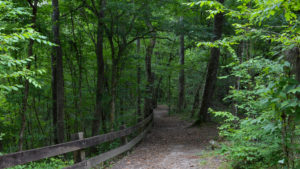
On the northern edge of Gainesville, the Devils Millhopper Nature Trail showcases all angles of the primary geologic feature in Devils Millhopper Geologic State Park.
You’ll walk around the a 500-foot-wide, 120-foot-deep sinkhole, circling it up top before descending into its depths along a 132-step series of stairs and landings to the bottom of this National Natural Landmark.
 A fence separates the trail from the dropoff at the sinkhole’s rim
Resources


Disclosure: As authors and affiliates, we receive earnings when you buy through our links. This helps us provide public information on this website.
Overview
Location: Gainesville
Length: 0.9 mile loop
Trailhead: 29.705809, -82.394255
Address: 4732 Millhopper Rd, Gainesville
Fees: $2 cyclist or pedestrian, $4 per vehicle
Restroom: at the interpretive center
Land manager: Florida State Parks
Phone: 352-955-2008
Open 8 AM to sunset daily. Leashed pets are welcome, but are not permitted on the staircase into the sinkhole.
There is a visitor center with an orientation film and restrooms, plus picnic benches out at the parking area.
Be cautious of poison ivy, which is prevalent along the sides of the footpath. Expect mosquitoes and use insect repellent.

Directions
From Interstate 75, take Gainesville exit 390 and head east into Gainesville on SR 222 for 3.4 miles, passing Santa Fe Community College. Turn left at the traffic light for NW 43rd Street. Drive 1 mile to NW 53rd Ave (Millhopper Road) and turn left. The park is on the right within a quarter mile.
Hike
From the parking area, follow the paved path past the ranger station and around the interpretive center.
Accessible exhibits provide interpretation of the geology and cultural history of the Devils Millhopper, including a short film in an open-air theater.
 Interpretive displays about the geology of Devils Millhopper
Past the interpretive center, the paved trail becomes a hard-packed sand path under the hickory and loblolly pine.
At the T intersection, turn right, so the plunge down the sinkhole is the last part of the hike.
 The nature trail makes a loop around the sinkhole
If the water table is high, you’ll hear the sound of running water, a good indicator that you’ll see waterfalls later in this walk.
The hardwood forest is heavy on oaks and hickories, so when the leaves are on the trees, you can’t see the sinkhole for the forest.
 Looking into the sinkhole from the woods above the rim
But you can certainly feel its presence, off to the left, where fencing discourages drawing close to the edge.
After a quarter mile, the trail winds past a communications tower and into a scrub forest, where silk bay and rusty lyonia are among the larger shrubs in the understory.
 Hiking through the scrub forest
There are frequent benches along this topside nature trail, so it’s not a challenge for folks with limited mobility.
A half mile in, reach a bridge over a ravine that wouldn’t look out of place in the Great Smoky Mountains. It arches over a creek steeply downhill towards the sinkhole.
 Large hardwood trees tower over the bridge and trail
Not far past the scenic bridge, a stone marker notes Devil’s Millhopper as a Registered Natural Landmark.
The staircase into the sinkhole starts behind it with a boardwalk, which parallels the creek flowing into the ravine.

The creek tumbles down a series of rock outcrops. Look closely at plants on the ledges.
Some of the more unusual species are wakerobin, a variety of trillium that blooms in late winter, and needle palms, which are more frequently found along humid spring runs.
 Ferns and wildflowers grow lushly around the cascades
As you drop deeper into the sinkhole, the landings afford better panoramas of the inside of this unique world. Listen for the sound of water.
Look towards the sound to see the various tall cascades that pour out of the water table when water is plentiful.
They tumble down the rocky sides of the sinkhole behind the lush plants and trees.

The final landing is a broad observation deck overlooking the bottom of the sinkhole. At the time we revisited – the day this new staircase opened – the sink was full of water.
It’s not always this way, but heavy rains this season can make it so. Walk to the end of the observation deck to see the waterfall coming down the near side of the sinkhole wall.
 Water always flows down the cascade that the staircase parallels
Depending on the time of year and the leaves in the way, you can sometimes see the waterfalls along the far wall of the sinkhole as well.
There’s no other way to go but up! Start your way back up the staircase.
 Looking up the steep staircase on the return climb
At the top, turn right for a quick walk over to the bridge over the ravine. It’s blocked off from this end as well.
Turn around and follow the fenceline back to the walkway to the exit path to the interpretive center, reaching the parking area after 0.9 miles.
 Devils Millhopper creates a cool microclimate where plants thrive
Trail Map

Explore More!
Learn more about Devil’s Millhopper Geological State Park
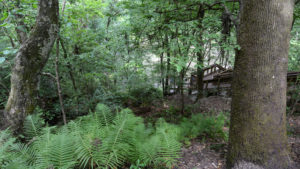 Devils Millhopper Geological State Park It's the trickle of water that catches your attention, the steady drip and splash down the rocky rim and into the depths of one of Florida's largest sinkholes at Devils Millhopper Geological State Park
Slideshow
See our photos of Devils Millhopper
Nearby Adventures
 Moonshine Creek Trails Delicate Appalachian wildflowers bloom in the deep shade of a slope forest surrounding Moonshine Creek, a stream that vanishes into an enormous marshy sinkhole.
 La Chua Trail Where Paynes Prairie drains into the Floridan Aquifer, alligators gather. Watch them from above along the La Chua Trail in the home of the Gators, Gainesville.
 Alfred A. Ring Park Featuring a dense slope forest along Hogtown Creek with old-growth trees and rare wildflowers along Appalachian-style ravines, this is a scenic hike in the heart of Gainesville.
 Mill Creek Preserve Slip through a curtain of pine plantation to discover a folded karst landscape with towering American beeches, spruce pines, swamp chestnut oaks, and a small waterfall on a 5.3 mile hike.

- Hal Scott Red Trail - November 13, 2026
- Baseline Trails - November 7, 2026
- Hal Scott Yellow Trail - November 3, 2026