
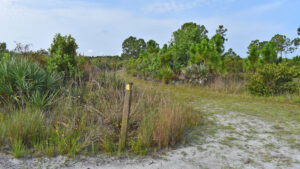
On the west side of expansive Juno Dunes Natural Area, this 2.4 mile trek at Juno Dunes West provides a deep immersion into the scrub.
Most of it is found along the 1.4 mile loop along the Sawgrass Trail and Scrub Hickory Trail. But as we’ve found, the trail system keeps going.
 Scrub is the dominant habitat along the loop
A mile-long round-trip off the loop leads to an observation deck along a mangrove-edged marsh, and a cove off Frenchman’s Creek.
Descending from dry to slightly squishy habitats, the trail provides a look at the full gradient of habitats found between the ridge and these brackish waters.
 Docks at the end of the trail
Resources





Disclosure: As authors and affiliates, we receive earnings when you buy these through our links. This helps us provide public information on this website.
Overview
Length: 2.4 mile round-trip and loop
Trailhead: 26.88808, -80.05878
Address: 14501 US 1 South, Juno Beach
Fees: Free
Restroom: At adjoining Loggerhead Park
Land manager: Palm Beach County
Phone: 561-233-2400
Open sunrise to sunset. No pets, bicycles, or drones allowed. A 0.4-mile round-trip is accessible, the remainder is natural surface.
Directions
From Interstate 95 exit 83, Jupiter, follow Donald Ross Blvd east 4.4 miles to US 1. Make the left turn from the leftmost lane onto US 1 and go a half mile north, passing Loggerhead Park. Make a U turn to head southbound on US 1 to the Juno Dunes West trailhead on your right.
Hike
Starting at the kiosk adjoining the parking area, the accessible Sawgrass Nature Trail leads into a Lilliputian scrub forest on a distinctly downhill slope.
The ancient sand dunes of the Atlantic Coastal Ridge are topped with diminutive oaks of the scrub – sand live oak, Chapman oak, myrtle oak – and silvery-blue saw palmetto.
 The hike starts out downhill
As the forest gets tall enough to block your view, the trail reaches a long boardwalk. Between the swales of the dunes is a thriving basin marsh, thick with Virginia willow.
Crickets kick up a persistent chorus. Royal ferns rise out of the dark water, shaded by wax myrtle.
 Boardwalk through the marsh
The boardwalk ends at a sheltered observation deck. From here, you can look east and see a similar shelter atop the Atlantic Coastal Ridge on the far side of US 1, at Juno Dunes East.
The accessible portion of the hike ends here, a round-trip of 0.4 mile. To continue on the trail system descend the steps to the undulating sand path.
 Shelter at the end of the Sawgrass Trail
This is the Scrub Oak Trail, which starts out as a trudge through soft sand. Look for delicate four-petal paw-paw, an endangered species that sports slender ivory blooms in spring.
Clumps of Florida rosemary rise from the brilliant white sand in the dunes on both sides of the trail. Hog plum sprawls across open sand as well.
 The broad sand path
Tall slash pines mark a transition into pine flatwoods as the trail descends, the footpath turning grassy under their shade.
Wildflowers bloom where the forest floor retains moisture, from sabatia in summer to tarflower, yellow-eyed grass, St. Johns Wort, and coreopsis in fall.
 Transition from scrub to flatwoods
At 0.4 mile, reach a trail junction. The loop back to the trailhead starts to the right. You’ll return to it after a round-trip from this point to the observation tower near the Intracoastal.
Continue straight ahead, following the yellow blazes on both posts and slash pines. Reach a T intersection around the next curve.
 Beneath the tall pines
A sign on the left helpfully points out that direction leads to Donald Ross Rd. Make a right to continue towards the tower, the pine flatwoods quickly becoming damp.
Expect puddles in the forest road that the trail now follows. As the pines thin, a marshy pond parallels the trail on the left, attracting ducks and wading birds.
 Wet flatwoods
The yellow blazes continue to mark the way, although side paths and clearings can confuse at a couple points, one with a beaten side path towards Frenchman’s Creek.
Rising up and over a small ridge with clumps of saw palmetto and scattered trees, the trail curves around to the tower. Climb up for a view of a mangrove-edged lagoon.
 Looking down from the tower
Beyond the observation tower is another paved walkway. It leads through a coastal hammock to a cove off the Intracoastal Waterway, a mile into this hike.
A long boardwalk extends across the cove to floating docks suitable for large boats. A picnic area is along the shoreline.
 Walking back to shore from the docks
From this distant point on the trail system, retrace your steps to the tower and back along the forest road to the intersection with the “Donald Ross” sign. Make a left.
Continue back to the previous trail intersection, the loop off the Scrub Oak Trail. It’s at 1.4 miles. Make a left.
 Trail junction for the Scrub Hickory Trail
The forest road climbs rapidly into the scrub. A blaze post confirms the route, edged by dense low scrub largely smothered in love vine.
As the density of the scrub relaxes, there are grassy patches between the saw palmetto. Curving right, the trail reaches a low spot with a thin film of standing water.
 One of the grassy patches
It’s a big surprise to be surrounded by scrub and yet see bladderworts and pink sundews at your feet.
Goldenrod thrives here, too, along with bog buttons. Young pine flatwoods dominate the north side of the trail through this boggy swale.
 The first of several boggy swales
At a T intersection, turn right and pass between a few more boggy swales that invite inspection for their diversity of plants.
The trail starts climbing out of this damper area, headed steadily uphill to where the soil underfoot becomes soft sugar sand.
 Trail junction among the swales
Footing is difficult. Several more perched wetlands are along this section on the right, with short side trails leading down to them.
By comparison, prickly pear cactus grows on the hills to the left, and the strum of the ocean begins to reach your ears.
 Steep climb on the return trip
Go up and over the ridge, and the condos along US 1 north of the preserve become obvious, as does the depth of the soft sand ahead.
To the right and downhill, the marsh that the boardwalk crossed is now obvious, cattails waving in the ocean breeze.
 The observation shelter at Juno Dunes East is visible across US 1
Keep right at the fork as the trail approaches US 1, and turn around to see the sweep of the landscape you’ve hiked through.
The hike concludes with a final stretch of soft sand up to a gate leading into the parking area. Walk through the pass-thru to complete this 2.4 mile hike.
 Panorama across Juno Dunes West
Trail Map

Explore More!
Learn more about Juno Dunes Natural Area
 Juno Dunes Natural Area Preserving a sliver of the Atlantic Coastal Ridge at the north end of Juno Beach, this expansive preserve extends from the Intracoastal Waterway to A1A.
Video
Slideshow
See our photos of Juno Dunes West
Nearby Adventures
More worth exploring while you’re in this area.
 Juno Dunes East Summit the natural high point of Palm Beach County on an easy loop along the east face of the Atlantic Coastal Ridge between US 1 and A1A in Juno Beach.
 Frenchman’s Forest Natural Area Four hiking trails intertwine in this 172-acre natural area, with seven different habitats to explore along footpaths, paved trails, and boardwalks.
 John D. MacArthur Beach State Park With a rare stretch of natural beach and tropical hammock along the Atlantic Ocean in Palm Beach County, John D. MacArthur Beach State Park is a popular getaway.
 Loxahatchee Slough Natural Area Escape to a vast watery wilderness where you can hike, bike, or paddle through Northern Everglades habitats on the outskirts of residential Palm Beach County

- Michael Crotty Bicentennial Park - November 3, 2026
- A.J. Henry Park - November 1, 2026
- Okeeheelee Nature Center Trails - October 22, 2026