
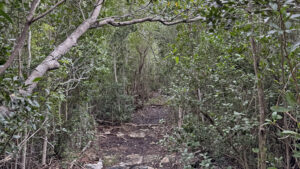
John J. Pescatello Torchwood Hammock Preserve was acquired by the Nature Conservancy in 1989 to protect rare natural habitats in the Lower Keys.
The property protects nearly 244 acres, although the hammock only exists in a small area at the south end.
Inconspicuously marked with signs on a chain-link gate, it is easy to overlook this scenic trail and its varied tropical landscapes.
 Entrance gate
Resources





Disclosure: As authors and affiliates, we receive earnings when you buy through our links. This helps us provide public information on this website.
Overview
Location: Little Torch Key
Length: 0.4 mile
Trailhead: 24.654361, -81.387833
Address: Pirates Rd, Little Torch Key
Fees: Free
Restrooms: None
Land manager: The Nature Conservancy
Phone: 561-744-6668
Open sunrise to sunset. No pets allowed. Call The Nature Conservancy for access if the gate is locked.
Because of the presence of poisonwood trees, it is best to avoid touching any of the plants in the hammock.
Directions
From the National Key Deer Visitor Center on Big Pine Key, follow US 1 south 2.2 miles. Right after crossing North Pine Channel to Little Torch Key, make a left on Pirates Rd. Follow it 0.8 mile to the end of the road.
Hike
Walking through the preserve gate, follow a well-defined rocky footpath lined with dense shrubs that gradually increase in height while heading down the trail.
Slender torchwood trees border the narrow corridor alongside white stoppers and gumbo limbo.
A member of the citrus family, torchwood is a host plant for swallowtail butterflies, producing fragrant white flowers nearly year-round.
 Torchwood with identification tag
Stay to the left at a fork in the trail, noticing how quickly the foliage changes while approaching the ocean.
Grasses and salt tolerant succulents carpet the forest floor as buttonwood and mangrove trees become more prominent.
 Habitat transition
As the trail winds out towards a coastal berm, curious canals intersect the path, remnants of past mosquito control projects that saw drainage channels cut directly into the limestone.
A thin layer of slick marl mud covers the ground as markers lead the way past tree skeletons with gnarled, sun-bleached limbs.
 Bridge over an old channel
The trail opens to a wide clearing at 0.2 miles, where a bench and dedication plaque sit in a tidally flooded ecosystem amongst the mangroves.
From this quiet spot, backtrack 200 feet and turn left at the next junction to explore the other side of the loop.
 Plaque and bench in the salt flats
Tidal flats quickly transition to hardwood hammock with a slight rise in elevation, shading the path as it weaves through a dense jungle with limestone pavement.
A large poisonwood tree with an identification tag arches over the trail before the loop concludes, where a short walk leads back to the trailhead.
 Tropical rockland hammock
Trail Map

Explore More!
Video
Hiking Torchwood Hammock Preserve
Nearby Adventures
 National Key Deer Refuge Established in 1957 to prevent the extinction of the diminutive Key deer, National Key Deer Refuge spans 84,351 acres across 25 islands in the Lower Keys.
 Key West Tropical Forest & Botanical Garden Boardwalks and footpaths wind through curated plant collections against a backdrop of natural habitats at the Key West Tropical Forest & Botanical Garden.
 Curry Hammock Nature Trail An immersion into a tropical rockland hammock thick with rare Florida thatch palms, this rugged path leads to a bench overlooking the placid waters of Florida Bay.
 Key Tree Cactus Preserve Protecting an endangered species of cactus only found in the Keys, Cuba, and the Bahamas, Key Tree Cactus Preserve showcases a tropical hardwood hammock edged by mangroves.

- Calusa Heritage Trail - November 5, 2026
- Scherer Thaxton Preserve - October 21, 2026
- Little Awesome Preserve - October 19, 2026