• Skip to main content
  • Skip to header right navigation
  • Skip to after header navigation
  • Skip to site footer
Florida Hikes logo

Florida Hikes

Hike Bike Paddle Camp Florida with authors Sandra Friend and John Keatley as your guides

  • Trails
  • Maps
  • Guidebooks
  • Hike
    • Scenic Hikes
    • Loop Trails
    • Dog-friendly Hikes
    • Hikes for Kids
    • National Parks in Florida
    • Florida State Parks
  • Bike
    • Major Bike Trails
    • Paved Bike Trails
    • Off Road Biking
    • Biking Articles
  • Paddle
    • Canoe & Kayak Rentals
    • Paddling Destinations
    • Paddling Articles
  • Camp
    • Cabin Rentals
    • Car Camping
    • Primitive Camping
  • Florida Trail
    • Plan your Hike
    • Best Scenic Hikes
    • Best Backpacking
    • Section Hiking
    • Thru-Hiking
    • Trail Updates
  • Travel
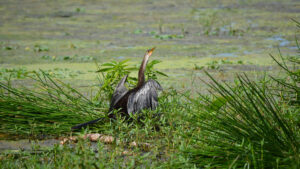
Anhinga drying its wings along a wetland

Anhinga

Surfacing from their dives to chase fish, anhingas, with their long necks, look like snakes at attention, which is why they are known as snakebirds, or water turkeys.

Florida is a land of swamps, wetlands, and sheltered, slow-moving streams – perfect habitat for the anhinga, a distinctive bird that can be seen year-round in virtually every part of the state.

Anhinga on a tree branch Anhinga perched on a riverfront cypress


Identifying an Anhinga

A common sight in Florida, these large, slender waterbirds are easily recognized for two behaviors.

First, the “snake” thing, because they swim with just their head and neck above the surface and look like a snake moving through the water.

Neck of anhinga sticking out of water
Anhinga surfacing after diving

Next, back on shore after a snack and a swim, they perch on branches or logs with their wings and tail outspread.

Unlike other waterfowl, they do not have waterproof feathers and have to rely on Mother Nature to dry them off.

Anhinga perching on a tree base Often they can’t fly into a tree to dry off, but do so barely out of the water


In addition to a long, S-shaped neck and a dagger-like bill, they have fanlike tails that resemble a turkey’s (which prompts their other nickname, water turkey).

Males are 34 to 36 inches tall and weigh, on average, about 2.7 pounds. They are glossy black with silver/white feathers on their wings and the tip of the tail.

Their bills, legs, and webbed feet are yellow to yellow-orange, and their eyes are blood red, except during mating season when they are encircled by a blue patch of skin.

Close up of anhinga Male anhinga


Females are of similar size and plumage, but their heads, neck, and breasts are browner than the male’s.

Newly hatched anhingas are bald but develop a tan down within a few days. White down replaces the tan after a couple weeks, followed shortly by brown juvenile feathers.

Anhinga perched on log in river Young anhinga with downy neck feathers


Young birds stay mostly brown until their first breeding season, which is usually after their second or third winter.

Anhingas are frequently mistaken for double-breasted cormorants, which are of similar size, shape, and coloring. The easiest way to tell them apart is by their bills and tails.

Anhinga perched on log near river level Classic shape of tail and bill of anhinga


The anhinga’s tail is much wider and longer than the cormorant’s and the anhinga has a pointed bill while the cormorant has a hook at the tip.

In the air, the anhinga often rides thermals the way raptors and vultures do. Their slim bodies resemble a flying cross.

The head and tail stick straight out front and back and their wings are extended flat at their sides.


Where Anhingas Live

Members of the genus Anhinga live in warm, shallow waters and swamps worldwide. They prefer to nest in colonies with herons, ibis, storks and other waterbirds, building nests in tall trees near or overhanging the water.

Male anhinga in a red maple Male anhinga in a red maple


Anhingas live year-round in Florida. The species is also what’s known as a short-distance partial migrant.

Their range extends from coastal sections of the Carolinas and Texas south to Florida, Mexico, Cuba, the Caribbean, and South America. Birds that migrate usually fly north to breed in March or April and return south in October.

Anhingas feed in freshwater, using their pointed bill to spear medium-sized fishes hiding in submerged vegetation.

Their diet typically consists of mullet, catfish, suckers, sunfish, and similar species, rounded out by shrimp, crayfish, tadpoles, water snakes, small turtles, aquatic invertebrates and insects, and baby alligators.

Anhinga eating a fish
Anhinga swallowing a fish

How Anhingas Nest

Anhingas like quiet surroundings in which to raise their young. They generally nest on the shores of sheltered waters such as freshwater marshes, wooded ponds, cypress swamps, and mangrove-lined lagoons.

Female anhinga drying her wings at the base of a cypress Female anhinga at the base of a cypress


Tall trees, especially dead ones, allow them to build nests as much as 20 feet above the waterline, which helps protect nestlings from predators including snakes, hawks, and alligators.

Anhingas are monogamous and form life-long pair bonds. Courtship starts when the male chooses a nesting site.

His mating display includes some impressive aerial swooping and diving as well as waving of his wings, raising his tail up over his back, and pointing his bill toward the sky and then bowing deeply.

Anhinga vocalizing Anhinga vocalizing


Both birds participate in building the nest. The male brings all the materials and begins the process by making a platform of bulky sticks and green materials in a fork of his chosen tree.

The female finishes the project, lining the nest with green leaves, twigs, willow leaves, and catkins from live oaks, laurel oaks, or Florida willows.

Anhingas may return to the same nest year after year or take over the nest of a heron or egret. Though some pairs prefer isolated locations, the majority choose to nest in mixed colonies.

These include similar-sized waterbirds such as herons, egrets, ibis and cormorants as well as other anhingas. Colonies can range from a few birds to several hundred pairs.

Mating starts in late winter or early spring and the female lays her eggs in the spring and early summer. Anhingas have one brood a year. The clutch averages four bluish to pale green eggs. though it may contain anywhere from two to six.

Both parents incubate and feed the chicks. Most chicks hatch at 25 to 30 days and fledge at around six weeks, though they may stay with mom and dad for several more weeks before becoming truly independent.

After about three weeks of age, the chicks can, if threatened – or curious – drop into the water for a swim, then climb back up the tree into the nest.


Where to See Anhingas

Here are a few locations where we have personally observed anhingas in Florida.

Blue Spring State Park
Known for being the best place in Florida to see manatees, Blue Spring is also a haven for anhingas and other birds. The wildlife draws hordes of hikers, cyclists, kayakers, and photo enthusiasts.

Anhinga Trail, Everglades National Park
If a place has “anhinga” in the name, you are pretty much guaranteed to see a few. Make that a lot. This trail is an effortless way for visitors to experience the vast, watery wilderness that covers much of South Florida. Be careful though – the alligators here are real and very close.

Anhinga drying wings Along the Anhinga Trail


Circle Bar B Reserve
This former cattle ranch located between Lakeland and Auburndale features restored wetlands – a favorite anhinga habitat – plus an extensive network of trails and fabulous birding opportunities.

Anhinga holding fish in beak Anhinga with its fresh catch at Circle Bar B


Chassahowitzka River Trail
Anhingas and other wildlife abound at this spring-fed river near the Gulf of Mexico. Dense and jungle-like, the trail gives visitors a glimpse of what Florida looked like in pre-colonial times.

  • Author
  • Recent Posts
G.K. Sharman
G.K. Sharman
G.K. Sharman has covered some territory, career-wise: News reporter. Award-winning magazine writer. Copy editor. Peace Corps volunteer. Independent journalist. AAA guidebook editor and Tour Book updater/fact checker. Landscape and event photographer. Not necessarily in that order. Now semi-retired, she works solely with a select group of clients, including Florida Hikes. Favorite places to enjoy nature with a photo-taking device: beaches, regional parks, and anywhere with swamp sunflowers.
G.K. Sharman
Latest posts by G.K. Sharman (see all)
  • American Flamingo - October 23, 2025
  • Anhinga - February 27, 2025
Category: BirdsTag: ID

Sidebar

Identify Florida Species

  • Birds in Florida
  • Insects in Florida
  • Plants and Trees in Florida
  • Wildflowers in Florida
  • Wildlife in Florida
  • Florida’s Habitats

Our Florida Books

Book cover of Florida Trail Hikes
The Florida Trail Guide fifth edition
50 Hikes in Central Florida 3rd edition
Explorer's Guide North Florida & The Panhandle guidebook
Five Star Trails Gainesville & Ocala guidebook
Five Star Trails Orlando guidebook

Florida Trail Apps

Farout GuidesFarout Apps Comprehensive logistics and offline maps for the
Florida National Scenic Trail (1,500 miles), the Florida Keys Overseas Heritage Trail (108 miles), and the ECT Florida Connector (92 miles).

FIND A TRAIL OR PARK

METROS: Bradenton. Clearwater. Crestview. Daytona Beach. Destin. Fort Lauderdale. Fort Myers. Fort Walton Beach. Gainesville. Jacksonville. Kissimmee. Lakeland. Melbourne. Miami. Naples. Ocala. Orlando. Panama City Beach. Pensacola. Port St. Lucie. Punta Gorda. St. Petersburg. Sanford. Sarasota. Sebring. Stuart. Tallahassee. Tampa. Vero Beach. West Palm Beach.

MULTI-REGION: Atlantic Coastal Ridge. Atlantic Coast. Bartram Trail. Big Bend. East Coast Greenway. Everglades National Park. Florida National Scenic Trail. Gulf Coast. Lake Wales Ridge. WATERWAYS: Indian River Lagoon. Intracoastal Waterway. Kissimmee River. St. Johns River. Withlacoochee River.

NORTHWEST FLORIDA: Altha. Apalachicola. Apalachicola National Forest. Big Bend Scenic Byway. Blackwater River State Forest. Blountstown. Bonifay. Bristol. Bruce. Cantonment. Cape San Blas. Carrabelle. Chattahoochee. Chipley. Crawfordville. DeFuniak Springs. Eastpoint. Ebro. Eglin Air Force Base. Freeport. Fountain. Gulf Breeze. Gulf Islands National Seashore. Holt. Madison. Marianna. Milton. Monticello. Mossy Head. Munson. Navarre. Navarre Beach. Newport. Niceville. Panacea. Panama City . Perdido Key. Ponce De Leon. Port St. Joe. Quincy. Santa Rosa Beach. Sopchoppy. South Walton. St. George Island. St. Marks. St. Marks NWR. Sumatra. Vernon. Wakulla. Wewahitchka. Woodville. WATERWAYS: Apalachicola River. Blackwater Bay. Blackwater River. Chipola River. Choctawhatchee Bay. Choctawhatchee River. Coastal Dune Lakes. Ochlockonee Bay. Perdido River. St. Marks River. Wacissa River. Wakulla River. Yellow River.

NORTH FLORIDA: Alachua. Amelia Island. Archer. Baldwin. Branford. Bronson. Bunnell. Callahan. Cedar Key. Chiefland. Crescent City. Cross City. Cross Creek. Dowling Park. Ellaville. Fanning Springs. Fernandina Beach. Flagler Beach. Fort White. Glen St. Mary. Green Cove Springs. Hawthorne. High Springs. Inglis. Jacksonville Beaches. Jacksonville Northshore. Jasper. Jennings. Keystone Heights. Lake Butler. Lake City. Live Oak.Macclenny. Mandarin. Mayo. Mayport. Micanopy. Middleburg. Old Town. Olustee. Orange Park. Osceola National Forest. Palatka. Palatka-Lake Butler Trail. Palm Coast. Palm Valley. Perry. Ponte Vedra. Rodman. Salt Springs. St. Augustine. Starke. Steinhatchee. Suwannee. Suwannee River Wilderness Trail. Suwannee Springs. Talbot Islands. Timucuan Preserve. Trenton. Waldo. Welaka. White Springs. Williston. Worthington Springs. Yankeetown. WATERWAYS: Santa Fe River. St. Marys River. Suwannee River. Tolomato River. Upper Withlacoochee River.

CENTRAL FLORIDA: Altamonte Springs. Apollo Beach. Apopka. Astatula. Astor. Auburndale. Bartow. Babson Park. Bayport. Belleview. Bithlo. Brandon. Brooksville. Bushnell. Canaveral National Seashore. Cassadaga. Christmas. Chuluota. Citrus Springs. Clearwater Beach. Clermont. Coast to Coast Trail. Cocoa. Cocoa Beach. Cross Florida Greenway. Crystal River. Dade City. De Leon Springs. DeBary. Deland. Deltona. Dunedin. Dunnellon. Edgewater. Enterprise. Eustis. Ferndale. Fort Meade. Frostproof. Geneva. Gibsonton. Haines City. Hernando. Hernando Beach. Holopaw. Homosassa. Inverness. Kenansville. Kissimmee. Lake Mary. Lake Wales. Largo. Leesburg. Lithia. Longwood. Lutz. Maitland. Malabar. McIntosh. Melbourne Beach. Merritt Island. Merritt Island NWR. Mims. Mount Dora. Narcoossee/Lake Nona. New Port Richey. New Smyrna Beach. Nobleton. Oak Hill. Oakland. Ocala National Forest. Ocklawaha. Ocoee. Oldsmar. Orange City. Ormond Beach. Osteen. Oviedo. Paisley. Palm Bay. Plant City. Poinciana. Polk City. Ponce Inlet. Port Orange. Ridge Manor. Riverview. Ruskin. Safety Harbor. Silver Springs. Sorrento. Spring Hill. St. Cloud. Tarpon Springs. Thonotosassa. Titusville . Umatilla. Viera. Walt Disney World. Weeki Wachee. Weirsdale. Wimauma. Windermere. Winter Garden. Winter Haven. Winter Park. Winter Springs. Withlacoochee State Forest. Withlacoochee State Trail. Yeehaw Junction. Zephyrhills. WATERWAYS: Alafia River. Halifax River. Hillsborough River. Lake Apopka. Little Manatee River. Ochlawaha River. Rainbow River. Tampa Bay. Wekiva River. Wekiva River Basin.

SOUTHWEST FLORIDA: Alva. Boca Grande. Cape Coral. Charlotte Harbor. Ding Darling NWR. Ellenton. Englewood. Estero. Immokalee. Marco Island. North Port. Osprey. Palma Sola. Palmetto. Pine Island. Port Charlotte. Sanibel Island. Venice. WATERWAYS: Caloosahatchee River. Manatee River. Myakka River. Pine Island Sound.

SOUTH FLORIDA: Arcadia. Basinger. Big Cypress National Preserve. Big Cypress Seminole Reservation. Big Cypress Swamp. Bowling Green. Clewiston. Everglades City. Indiantown. LaBelle. Lake Okeechobee Scenic Trail. Lake Placid. Lakeport. Moore Haven. Okeechobee. Ortona. Pahokee. Palmdale. Port Mayaca. South Bay. Wauchula. Zolfo Springs. WATERWAYS: Fisheating Creek. Lake Okeechobee. Peace River.

SOUTHEAST FLORIDA: Biscayne Bay. Biscayne National Park. Boca Raton. Boynton Beach. Coconut Creek. Coral Gables. Coral Springs. Davie. Delray Beach. Fellsmere. Flamingo. Fort Pierce. Hobe Sound. Hollywood. Homestead. Indrio. Jensen Beach. Juno Beach. Jupiter. Jupiter Farms. Key Biscayne. North Hutchison Island. Ocean to Lake Greenway. Palm Beach. Palm Beach Gardens. Pompano Beach. Redland. Sebastian. South Hutchinson Island. WATERWAYS: Florida Bay. St. Lucie River.

FLORIDA KEYS: Big Pine Key. Islamorada. Key Largo. Key West. Marathon. Overseas Heritage Trail.


©2006-2026, Sandra Friend & John Keatley | Disclosure | Site Index | Work with Us | Advertise with Us | Terms of Service and Privacy Policy

Florida Hikes PO Box 93 Mims FL 32754 | Contact