
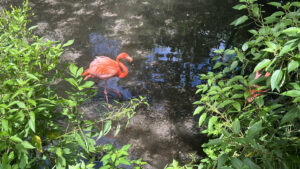
The American Flamingo is one of the largest flamingo species worldwide. Native to Florida and the Caribbean, these highly social creatures love to congregate in large, boisterous flocks often – appropriately – called flamboyances.
Though native to the Sunshine State, they were hunted to near extinction between the late 1800s and the early 1900s to serve the whims of fashion.
 Flamingos prefer close company
Identifying a Flamingo
One of the largest of its species, the American flamingo averages about five feet tall, thanks to its stilt-like legs and long S-shaped neck, and weighs between four and eight pounds.
Males are usually somewhat larger than females in terms of height, weight, and wingspan, but there are otherwise no differences between the sexes. Telling the adults apart from a distance is practically impossible.
Flamingos have black on the edges of their wings – more visible when they are flying – and on their secondary feathers, as well as the tip of their thick, upside-down looking bills.
Adult flamingos also have pale yellow eyes. Other than that, the pink continues down their legs to their webbed feet and also appears on part of their bill.
 Close up of a flamingo’s bill
The young are white and gray, gradually turning pink around the time they reach three years old.
The adults’ prominent pink plumage comes from their diet of algae, brine shrimp, and other aquatic invertebrates.
Unfortunately, those flashy feathers once made them all the rage for ladies’ hats and fans. The birds also were hunted for their meat, which was available at specialty markets.
Florida populations today are not what they once were, but research indicates that long-term numbers tend to be stable and positive.
 A small captive population of injured birds resides at Homosassa Springs
Where Flamingos Live
American flamingos are coastal dwellers that prefer shallow, often salty waters.
Their range extends from the Yucatan through the Caribbean to the Bahamas, south to Venezuela and west to Ecuador and the Galapagos.
In Florida, they congregate overwhelmingly in the Everglades, the Keys, and the state’s southern wetlands. However, we’ve also spotted them farther much north.
A captive population of flamingos was established in the 1930s at Hialeah Park Race Track (now Hialeah Park Racing & Casino).
The flock successfully reproduced in non-wild conditions and has become a notable breeding colony as well as a popular draw for tourists. The racetrack infield was eventually named a National Audubon Sanctuary.
Though American flamingos can easily fly long distances at high altitudes, they are considered non-migratory.
Their favorite foods – blue-green algae, brine shrimp, and other small crustaceans that give them their notable pink color – determine where they choose to live.
Flamingos have an odd but very efficient way of eating – they lower their curved beaks top down into the water and swish their heads from side to side.
 Flamingo feeding
Their specially adapted filtration system inside their beaks separates the mud and water from the edible organisms, which allows flamingos to live in environments where other creatures would be unable to find food.
Fun fact: Flamingo chicks are born with straight bills. As they grow, the beaks develop the distinctive curve that marks their species and enables them to self-feed.
Flamingos, with their webbed feet, are total ground dwellers. They stand on one leg to rest, drawing their other leg up under their bodies – a position that seems uncomfortable to humans but is secure and comfy for these long-legged avians.
 A flamingo at rest
How Flamingos Nest
When it comes to raising the next generation, flamingos have some priorities. As social birds, they love being in large, noisy communities with their fellow pink fowl. Colonies in the wild can contain hundreds or even thousands of birds.
They also need to be near their marine food source, so they opt to construct nests of mud, stones, straw, or feathers on mud or salt flats near the edges of warm, shallow lagoons or mangrove swamps.
Outside of Florida, flamingos may use mud to make volcano-shaped cones (in the Caribbean) or gather small piles of rocks and debris (as in the Galapagos).
Nests are about a foot tall and slightly concave in the center to protect the egg.
Flamingos do not nest seasonally and do not always return to the same nesting areas year after year. Instead, weather conditions – particularly rainfall, which affects their food supply – determine when and where they choose to breed.
They generally nest once a year and tend to choose their locations as a flock. Their habit of synchronous nesting helps ensure that the chicks in the colony hatch around the same time in any given year.
Flamingos are believed to be monogamous – though some have been seen mating with more than one partner. They also engage in group courtship rituals.
 A pair of captive flamingos
Colorful and energetic, these displays are a sight to see and hear and include coordinated marching, head turning, and wing flapping.
Females often make the first move when choosing a mate and both mom and dad build the nest.
Females most often lay one egg per season, though they may sometimes have two. The adult birds also cooperate on incubating the egg and caring for the chick.
The young hatch after about thirty days. Like pigeons, parents feed them with a crop milk, “flamingo milk,” a special protein- and fat-rich liquid produced in their digestive tract.
When the hatchlings are a couple of weeks old, they go hang with their squad in a sort of flamingo nursery known as a creche. Several adults monitor the young ones, but parents continue to come by to feed their individual chicks.
The young fledge and can self-feed between 9 and 13 weeks. Born gray and white, they develop their adult pink coloration at around age 3 and reach reproductive maturity between three and six years of age.
Where to See Flamingos in Florida
As iconic as flamingos are to Florida’s image, they can be a challenge to locate outside of captivity. Here are some places to try.
Flamingo Gardens
Located near Davie, this non-profit botanical sanctuary is one of the oldest garden attractions in South Florida. It features a staggering number of orchids and gingers, plus native and exotic trees and plants. It’s also home to injured and non-releasable Florida wildlife, including gators, eagles, panthers, bobcats and – of course – flamingos.
 Flamingo Gardens A nonprofit botanical garden with its roots in a citrus grove, Flamingo Gardens began with tropical trees planted in 1928, now giants among the thematic gardens across 60 acres of Davie.
Snake Bight
Like to venture out on the edge? This wild stretch of Everglades National Park near the southern tip of Florida is one of the best places to see flamingos in their natural habitat, especially between late March and early May. The area is popular with birders and hikers – and mosquitos. Remember your bug spray.
 Snake Bight / Rowdy Bend The Snake Bight Trail in Everglades National Park leads you a wild place where tropical forests meet the mangrove shorelines of Florida Bay, where crocodiles cruise the saline shallows and mosquitoes thicken the air.
Elliott Key
Located in the northern Keys, Elliott Key is the largest island in Biscayne National Park. A calm space within sight of densely populated Miami, this 8-mile-long stretch of sand is an important sea turtle nesting area and a haven for both native and rare or endangered plants and wildlife. Flamingos are just one of more than a hundred avian species here.
 Elliott Key In the northernmost of the Florida Keys, Elliott Key is the most remote place in Florida where you can take a hike in the shadow of a major city.
Merritt Island National Wildlife Refuge
Blown out of their regular Caribbean habitat by Hurricane Idalia, a group of flamingos first showed up at this Space Coast reserve in September 2023. Official bird counts and sightings by wildlife enthusiasts confirm that some appear to have settled in as a colony on an island offshore from Bairs Cove at Haulover Canal.
 Merritt Island National Wildlife Refuge With recreational activities ranging from hiking to biking, boating, fishing, and bioluminscent kayaking, Florida's top destination for birding is also home to Kennedy Space Center.
 Bairs Cove A go-to location for spotting manatees at Merritt Island National Wildlife Refuge, Bairs Cove off Haulover Canal is also a launch point for bioluminescence.
Homosassa Springs Wildlife State Park
A flamboyance of flamingos is always gathered along the waterway circled by the Wildlife Walk at Homosassa Springs, birds unable to be returned to the wild due to various injuries. The boardwalk along their open-air habitat allows for easy viewing and photography of their natural behaviors.
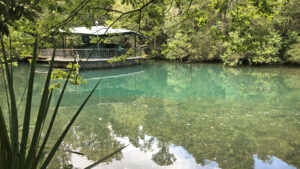 Homosassa Springs Wildlife State Park A former roadside attraction at the source of the Homosassa River, this Florida State Park showcases native Florida wildlife.
St. Marks National Wildlife Refuge
Pinky the Flamingo has become an icon at this expansive coastal refuge south of Tallahasee along Apalachee Bay on the Gulf of Mexico. Ask at the Visitor Center regards birders’ most recent sightings or check social media and birding apps for recent updates.
 St. Marks National Wildlife Refuge Stretching across 86,000 acres in Florida's Big Bend, St. Marks National Wildlife Refuge protects one of Florida's longest wild shorelines, more than 43 miles in three counties.
For more about birding in Florida, see our Birding page.

- American Flamingo - October 23, 2025
- Anhinga - February 27, 2025